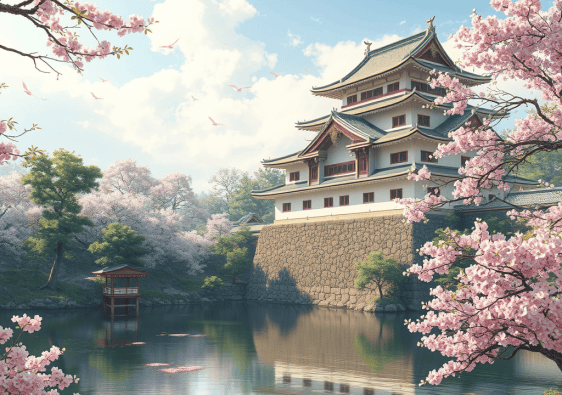
Nestled in the city of Fujieda, Shizuoka Prefecture, Tanaka Castle is a quiet historical site but rich in feudal stories. Although few original structures remain, it offers a fascinating insight into Japanese defensive architecture and the organization of domains under the Tokugawa Shogunate. This little frequented place makes it possible to discover, in quiet, an unknown part of the history of Japan.
Historical context of Tanaka Castle
Tanaka Castle was built in 1537 by the Isshiki clan, on the order of the Imagawa, as a strategic point to defend the Sunpu region. He was quickly involved in the conflicts of the Sengoku era. In 1570, Takeda Shingen, a dreaded military chief, made the site. He then entrusted his management to his generals, notably Yamagata Masakage, then Inagaki Nobuyasu.
After the fall of the Takeda clan, the castle passed under the control of Tokugawa Ieyasu, who made it a place of residence when he was staying in Sunpu. Its use was both political and personal, particularly for falconry. This site is also known as the place where Ieyasu would have eaten a fish tempura dish (tai) just before falling ill, which would have contributed to his death.
A unique defensive architecture
One of the peculiarities of Tanaka Castle is its circular configuration, rare among Japanese castles. The plan consisted of four concentric moats, an innovative defensive element for the time. In its center was a two-storey, modest-sized tenshu (donjon). The purpose of a circle arrangement was to slow down the attackers and control their movements in the enclosure.
Although the castle was largely dismantled in the Meiji period, some moats and foundations are still visible today. A large yagura (watch tower) was rebuilt in 1992 to house a museum tracing the history of the site and the region. This type of reconstitution is common in Japan, where few castles have retained their original structure.
The role of the castle in the Han system
During the Edo era, Tanaka Castle served as the administrative center for Tanaka estate (han). He was entrusted to various daimyos, mainly fudai (hereditary vases of Tokugawa). This system of clan rotation in castles was intended to guarantee fidelity to the Shogunate.
In 1730, a branch of the Honda clan settled in Tanaka. The castle gradually lost its military role to a more administrative and symbolic use. He remained occupied until the end of the Shogunate, before being abolished with the territorial reform led by the new Meiji government after 1868.
What remains to be seen today
Although few original elements remain, the Tanaka Castle site has several points of interest for those passionate about history and architecture:
- The yagura rebuiltThis two-storey tower houses a permanent exhibition on the history of the castle, the clans that occupied it and local customs.
- Circular moats: partially preserved, they give an idea of the atypical defensive plan of the castle.
- The garden and tea house: integrated into the space of the current park, they offer a pleasant setting for a break or a walk.
- Doors and outbuildings relocatedSome elements, such as a door to Kyokutenin temple, come from buildings of the original castle.
- Rice attic vestiges and samurai dwellingsThey testify to the logistical and social organization of the field.
The castle is now integrated into a public park and adjoins a school, making it a quiet and accessible place, but which requires a little imagination to reconstruct its original look.
Practical tips for the visit
To reach Tanaka Castle, the simplest is to take the Tokaido line to the stationNishi-Yazu, then walk about 20 minutes to the site. This route can easily be inserted into a connecting routeSunpu (Shizuoka)and the surrounding castles asTakatenjinorSuwahara.
It is not necessary to allow much time for the visit:one to two hours is enoughto explore the current facilities, especially if you want to visit the museum in the yagura. The site is usually open every day, but it is advisable to check the local museum schedules.
For fans of feudal history, this castle can be an interesting step off the beaten track, away from the large crowds of Himeji or Matsumoto.
Cultural recommendations
During your visit, pay attention to the cultural elements present in the garden, including the tea house, sometimes used for local events. If you have some knowledge of Japanese, engage in a conversation with the guides or volunteers present: their explanations often provide valuable insight into the anecdotes related to the castle.
For a complete experience, it may be interesting to combine the visit with that ofSunpu CastleShizuoka, major residence of Tokugawa Ieyasu. You will see a more complete reconstruction of the fortifications, in addition to the more modest but historically significant site of Tanaka.
Tanaka Castle, although largely disappeared, remains an evocative place of the Japanese feudal era. Its unique plan, the narratives that surround it, and its integration into the local fabric make it a discreet but enriching step for curious travellers of history. Visiting this site leads to a more intimate side of the Tokugawa heritage, far from the classic tourist routes.
If this article has brought you useful information and can help other travellers prepare for their stay, a Google review will always be appreciated. |
|
Discover more from Evasions Rebelles - Travel Planner Japon
Subscribe to get the latest posts sent to your email.