Kendama is much more than just a toy: it embodies centuries of history, a unique artisanal wealth, as well as an art of movement and concentration appreciated throughout Japan and beyond. From its uncertain origins to its international popularity, it goes through times while adapting to contemporary creativity.
What is a kendama?
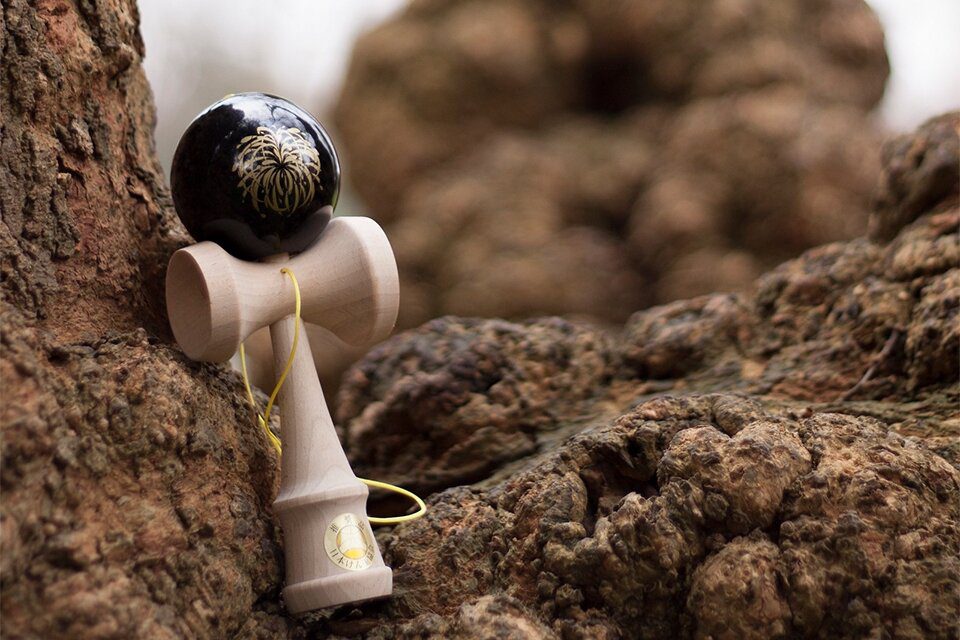
The kendama is a wooden toy composed of two main elements: a cross-shaped handle, called “ken” (which means “sabre”), and a ball pierced by a hole, called “tama” (the ball). These two parts are connected by a rope. The objective is to perform various figures consisting of throwing the ball in the air to catch it with one of the three cups of the handle, or to fit on the tip.
The object lends itself to many techniques and combinations, ranging from basic figures to spectacular chains of competitive level. In Japanese, each movement has a name, and the practice of kendama is often compared to a martial art in miniature, seeking concentration, hand-eye coordination and rhythm.
A fuzzy origin but ancient roots
The kendama is part of a family of toys present throughout the world, in different forms. Similar objects can be found in Europe as early as the 16th century, notably in France with the “bilboquet”, in Germany with the “Kugelfang”, and in Mexico with the “balero”. All are based on the same principle: throw and catch a ball with a stick, with or without rope.
In Japan, the first documented records date back to the late eighteenth century. The term “ken-dama” appears in Edo’s writings, while a similar toy appears in illustrations dated 1809. The object would have been introduced via the port of Nagasaki, then only open to foreign trade. It is likely that the concept was adapted locally and then transformed to meet Japanese tastes and uses.
Innovation of nichigetsu ball in Hiroshima
It was in 1918, in the town of Kure (Hiroshima Prefecture), that a craftsman named Egusa Hamaji designed an improved version of the traditional kendama. He adds three cups (two sides and one at the base) to the handle in addition to the tip, creating a whole new game dynamic. He filed a patent under the name “Nichigetsu ball” (the Sun-Lune ball), referring to the shape of the toy and its symbolic balance.
It is this form, with three cups, which today constitutes the standard model of Japanese kendama. Manufacturing developed from the 1920s in Hatsukaichi, near Hiroshima, thanks to local carpentry know-how. The kendama then becomes a popular toy sold to visitors to the d’Itsukushima shrine and to travellers.
Kendama as an educational and cultural tool
From the Meiji era, kendama was promoted for its educational virtues. It is used in primary schools to develop fine motor skills, balance and perseverance among children. In parallel, it remains very present in the domestic sphere as a court or party game. It is also sometimes used in spiritual or symbolic contexts, for example to predict the future with the help of how the ball falls.
During the Showa era, kendama experienced several peaks of popularity, notably in the 1920s and 1970s. Contests are held in temples and schools, and the media relay the exploits of the best players. Production is concentrated in Hatsukaichi, which becomes the beating heart of kendama in Japan.
Official Recognition and Modern Evolution
In 2017, May 14 was officially recognized as the “Kendama Day” in Japan, in memory of the record of “Nichigetsu ball” in 1919. National and international competitions are held, and the best players are followed on social networks. Kendama is transformed into an artistic and sports discipline in its own right.
The design has also evolved. Although wood is always preferred for its grip and lightness, new materials such as plastic or metal are sometimes used for kendamas intended for stage or competition. Painted patterns become more varied, ranging from traditional aesthetics to contemporary graphics.
The international kendama: from Hiroshima to the world
Under the name “KENDAMA”, the toy exports to many countries, including the United States and Europe. Active communities of practitioners, local competitions and online tutorials allow this discipline to expand its audience. Kendama is particularly popular in urban culture and juggling and freestyle environments.
Japanese brands, but also American and European brands, now offer their models, sometimes co-created with artists or champions. Yet the purest amateurs remain attached to the kendamas made in Hatsukaichi, considered the most faithful to the original spirit.
The kendama today: crafts, heritage and passion
Even today, the city of Hatsukaichi continues the tradition of kendama, with family workshops, annual events, and a museum dedicated to the history of this object. Local artisans continue to turn, sculpt and paint each piece by hand. Kendama is also an excellent example of living heritage: it unites skill, popular culture and local memory.
Its global success increases interest in its practice in Japan, where it is often offered as a gift, used in schools or offered as an activity in museums and cultural houses. Kendama thus embodies a form of intergenerational and intercultural dialogue through play.
Kendama is not just a hobby. It reflects a transmitted know-how, an ever-renewed creativity and a subtle link between body and mind. From schoolyard to world championships, he continues to make the players vibrate, one jump at a time.
If this article has brought you useful information and can help other travellers prepare for their stay, a Google review will always be appreciated. |
|
Discover more from Evasions Rebelles - Travel Planner Japon
Subscribe to get the latest posts sent to your email.