In Japanese shrines and temples, a ritual gesture often accompanies prayer: shaking a cylinder, dropping a stick, and then swapping this stick for a folded paper. It is the omikuji, the good fortune paper that predicts luck or bad luck. Behind its apparent simplicity, the omikuji hides centuries-old history, various methods of drawing and a symbolism that goes far beyond mere prediction. Understanding this ritual means grasping a part of the daily spirituality of the Japanese and a tradition that continues to reinvent itself, between traditional prints and vending machines.
From ancient prints to 100 poems
The omikuji originated in the divine practices of Japanese antiquity. When deciding important questions for the country or choosing a successor, the drawing of lots was used to know the will of the gods. This practice, calledkuji, is considered the ancestor of the omikuji. The word itself consists of the honorary prefixmiandkuji, and is written with different characters depending on whether it comes from a Shinto shrine or a Buddhist temple.
The prototype of the omikuji as we know it today is attributed to Gansan Daishi Ryōgen, a Buddhist monk of the Xecentury. According to tradition, he received from Kannon Bodhisattva a hundred poems of five verses of four lines, and asked the faithful to draw one of these poems to know the way forward. It is this practice that comes from the use of the hundred numbered poems that are still found on many omikuji. The sticks bear a number, and the corresponding paper contains the poem and its explanation.
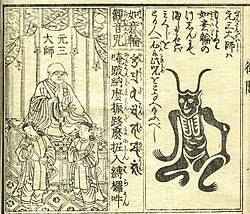
From the beginning of the Kamakura era, at XIIIeThe faithful began to draw their own omikuji to know their good or bad fortune. Today, the omikuji remains used in Shinto rites, notably to determine the order of participation in certain ceremonies or horses awarded at equestrian festivals. This continuity shows that omikuji is not just a simple entertainment, but a ritual tool still alive.
How to shoot an omikuji
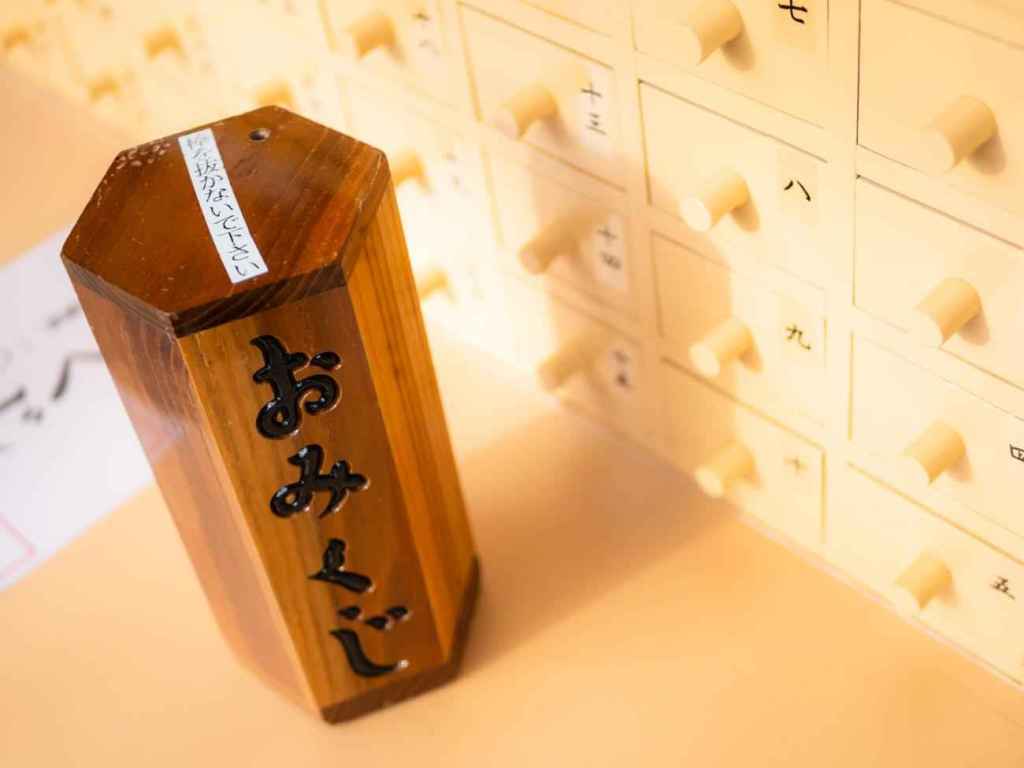
The most common method is to shake a cylinder or rectangular box containing long thin sticks, calledomikuji-bō. A stick exits through a small hole on the side, and the number at its end corresponds to a paper that is retrieved from the counter or from a locker provided for that purpose. This system is the one used for Gansan Daishi’s omikuji, considered original. In some shrines, such as Togakushi, it is the priests who draw the omikuji instead of the faithful, recite prayers.
Another method is to choose a pre-folded paper from a series arranged in a box or display. Since the 2019 pandemic, some sanctuaries have abandoned the cylinders in favor of this more hygienic formula. Finally, some establishments offer vending machines: parts are inserted equivalent to the purchase price, and the omikuji comes out of the machine. This practice has existed since the Taishō era, when a manufacturer filed a utility model for an omikuji vending machine.

Prices generally range from 100 to 300 yen depending on shrines and temples. Some offer omikuji in English for foreign visitors, and illustrated or thematic versions, especially for children. Most major shrines, such as Meiji Jingū in Tokyo or Fushimi Inari in Kyoto, have several types of omikuji, with different presentations and content.
What an omikuji contains
An omikuji usually consists of a number, an indication of good or bad fortune, and a main text that details several aspects of life. The most common categories include wishes, health, meetings, disputes, marriage, education, commerce and travel. Each category is accompanied by an explanation, sometimes in the form of Japanese poem (waka) or Chinese poem (kanshi), which gives advice or warnings.
The terms used to indicate wealth vary from one institution to another. The most common are:daikichi(high luck),Kichi(chance),chūkichi(average chance),shōkichi(small luck) andkyō(wrongs) Some shrines add intermediate categories, such ashankichi(half chance) orkomagoma(mixed chance). Others go so far as to propose variants likedaidaikichi(very good luck) ormukō daikichi(great chance to come).

The omikuji used to contain more warnings, which explains why bad fortunes were more frequent. Today, the ratio of good to bad fortunes varies according to the shrines, and some have reduced or even eliminated the number of bad fortunes. But the essential is not so much the result as the message: the explanations that accompany fortune are often more important than the label itself. They invite reflection and give directions for action.
Why tie his omituji
It is customary to attach the omikuji to the branches of the trees in the enclosure of shrines and temples. This practice dates back to the Edo era and is based on a set of words: the verb “attach” (musubu) is homophone to “link a relationship” in the field of love. To attach his omikuji to a tree is therefore to establish a link with the gods and entrust them with their destiny. Some shrines use specific supports to hang papers.
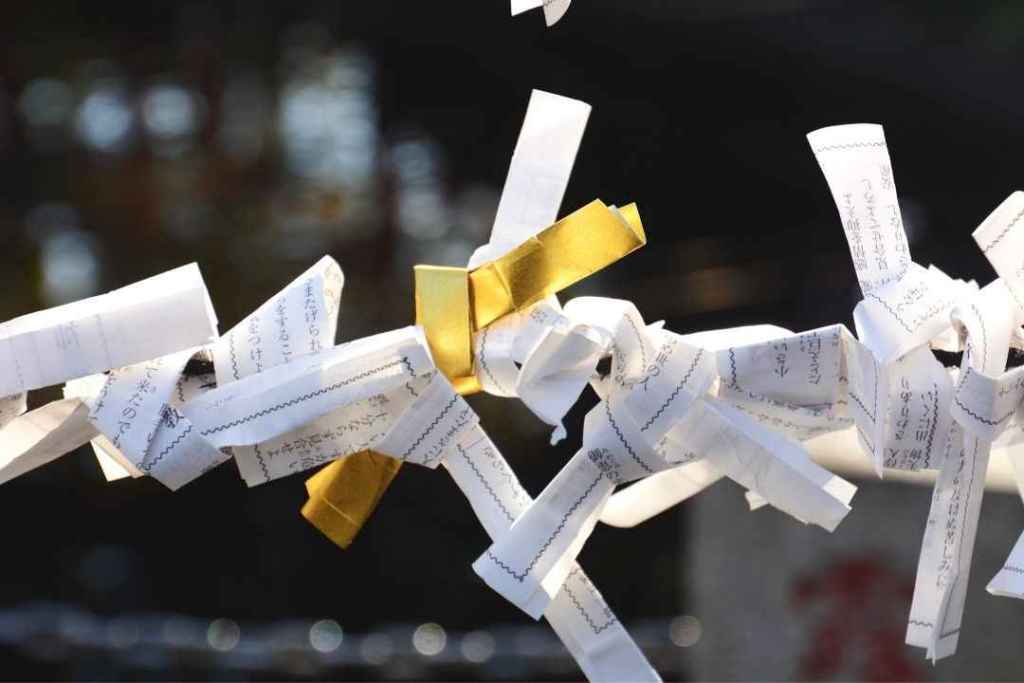
A popular belief is that bad fortunes are tied with the hand opposite its dominant hand to turn bad fate into good fortune. However, this practice has been questioned by some shrines, which have installed dedicated supports to prevent tree damage by links and papers. Today, many establishments offer racks or ropes stretched between two pillars to hang the omikuji, allowing to preserve the trees while respecting tradition.
The omikuji in the modern era
Today, the omikuji remains very popular in Japan, especially during the New Year’s visits, where millions of people go to the shrines to earn their fortunes of the year. Shrines and temples compete with ingenuity to offer original omikujis: shapes of hearts, cats, manga characters, or mini-objects to collect. Some establishments offer omikuji in several languages, including English, for foreign visitors.

Production is dominated by a manufacturer based in Shūnan, Yamaguchi Prefecture, which supplies nearly 70% of the country’s omikuji. Shrines can also design their own models, with poems, illustrations or specific messages. This diversity makes the omikuji an object both spiritual and cultural, reflecting the identity of each place.
Chinese prints and their cousinage
The practice of drawing lots to know the will of the gods also exists in China, where we speak ofqian. In Chinese temples, especially in Hong Kong or Taiwan, the faithful shake a bamboo cylinder with numbered sticks until a stick falls. They then throw two crescent-shaped objects, calledjiaobei, to confirm that the draw is correct. If the two objects fall face to face or face in the air, the drawing is refused and we repeat. If one is facing in the air and the other face against the ground, the draw is validated.
In Japan, Chinese prints are also found in some temples, such as Yokohama Chinatown’s Kantei-byō. These practices reflect an ancient circulation of divinatory rituals between China and Japan, and their adaptation to local contexts. For travelers, discovering these variants allows us to measure the richness and diversity of divinatory traditions in East Asia.

The omikuji is more than just a good fortune paper. It is a ritual that has its roots in the ancient history of Japan, an object that combines poetry, advice and spirituality, and a daily gesture for millions of Japanese. Whether you are believing or simply curious, pulling an omikuji during a sanctuary visit is a fun and introspective experience, which invites you to take a moment to reflect on your path. And if the paper announces a bad fortune, free to each one to attach it to a tree or a support, hoping that the wind or the gods will decide otherwise.
If this article has brought you useful information and can help other travellers prepare for their stay, a Google review will always be appreciated. |
|
Frequently Asked Questions
How much does an omikuji cost and where can we get one?
An omikuji usually costs between 100 and 300 yen depending on the sanctuary or temple. Most Shinto shrines and Buddhist temples in Japan include Meiji Jingū in Tokyo, Fushimi Inari in Kyoto and Tōdai-ji in Nara. Some institutions offer illustrated or thematic English templates for foreign visitors. It is customary to draw an omikuji after praying and making an offering, but there is no strict rule. Vending machines also allow you to buy them without going through the counter.
What if we get a bad fortune?
It is customary to attach the bad omikuji to a support provided for this purpose in the enclosure of the sanctuary or temple. This practice, inherited from the Edo era, consists in entrusting its bad fate to the gods by tying paper to a branch or rope. A popular belief recommends attaching it with the hand opposite its dominant hand, but this practice is not universal. The important thing is to read carefully the message that accompanies the fortune, as advice is often more useful than the label itself.
What is the origin of omikuji?
The omikuji originated in the divine practices of Japanese antiquity, when the drawing of lots was used to know the will of the gods on important issues. The prototype of the modern omikuji is attributed to Gansan Daishi Ryōgen, a Buddhist monk of the Xecentury, which would have received one hundred poems from Kannon Bodhisattva and asked the faithful to draw one to know their way. It is from this practice that the hundred numbered poems come that are still found on many omikuji, with a stick bearing a number and a corresponding paper.
What are the different methods of drawing an omikuji?
The most common method is to shake a cylinder with numbered sticks and then exchange the stick for paper at the counter. Some shrines, such as Togakushi, have the omikuji pulled by the priests. Another method is to choose yourself a pre-folded paper from a series. Finally, vending machines allow to obtain an omikuji by inserting parts. Since the 2019 pandemic, some establishments have abandoned cylinders in favour of more hygienic formulas, where the faithful choose their paper directly.
Are omikuji different according to the shrines?
Yes, omikuji vary considerably from sanctuary to sanctuary. The terms used to indicate wealth, categories and poems differ. Some shrines offer omikuji with Japanese poems (waka), others with Chinese poems (kanshi), and some do not indicate good or bad fortune, but only advice. The presentations are also varied: folded papers, rolls, objects to collect, English versions. This diversity makes omikuji a cultural object reflecting the identity of each place.
Can we find omikuji outside Japan?
Yes, there are omikuji in some Japanese temples abroad, especially in Hawaii, where they are exported. The practice of drawing lots also exists in China, where we talk aboutqian, with similar methods: a bamboo cylinder containing numbered sticks, and crescent-shaped objects to confirm the draw. In Japan, some Chinese temples, such as Yokohama Chinatown’s Kantei-byō, also offer such drawings, reflecting the ancient circulation of divinatory rituals between China and Japan.
Discover more from Evasions Rebelles - Travel Planner Japon
Subscribe to get the latest posts sent to your email.