A landmark in Japan’s history, the rōnin immediately evokes the image of a solitary warrior evolving on the margins of a strict system. To understand this fascinating status, one must explore its origin, its role in feudal society, its cultural representations and the places in Japan where one can still feel the imprint of these wandering samurai. This article offers a clear and practical light to enrich a trip to Japan, while giving essential historical landmarks to better understand the complexity of this character.
Origin of the term and historical evolution
The word rōnin literally means “wave man”, an expression that refers to the idea of an individual drifting, without attachment or hierarchy. At the time of Nara, he often identified serfs who had deserted their master. Later, the term applied to samurai who had lost their lord, whether because of death, internal conflict or personal fault. In a feudal Japan based on absolute loyalty, the loss of the master meant the collapse of an identity and the obligation to find a new way.
As conflicts increased, especially during the Sengoku period, the number of rōnin increased. Political instability, clan changes and the war economy created a large population of unmarked warriors. Some went to the service of various lords, others chose to live independently, sometimes in poverty, sometimes in a personal quest for martial perfection.
Rōnin in Japanese society
At the Edo era, the status of rōnin becomes more visible. The rigid laws of the Shogunate prevented the samurai from changing masters without permission, which, in the event of the Lord’s death or disgrace, automatically plunged the warriors into a delicate situation. Feudal society often viewed them with distrust: a rōnin was perceived as unstable and potentially dangerous. Yet some villagers saw them as protectors capable of opposing injustices. Many stories – sometimes based on real facts – describe rōnin defending the weakest.
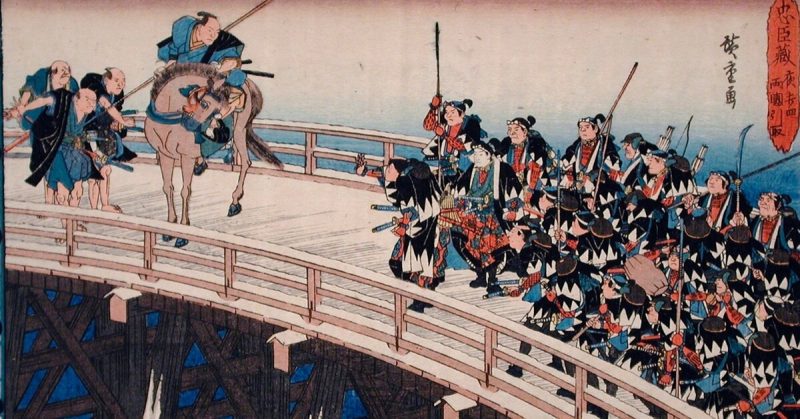
The legend of the 47 rōnin perfectly illustrates this ambivalence. Their quest for revenge against the person responsible for the death of their master has shaped the ideal vision of determined rōnin, courageous and faithful to a strict moral code, even when it no longer depends on anyone. Others, like Miyamoto Musashi, embody personal ascent through martial discipline, becoming a reference for the admiration of subsequent generations.
New meanings in modern Japan
After the abolition of the samurai class in the Meiji era, the term rōnin evolved to refer to persons in transition, including students who failed their university entrance exams or unemployed workers. The word then evokes a period of uncertainty, but also the determination to pursue an objective. This contemporary adaptation shows how deeply the figure of the rōnin remains rooted in the Japanese imagination.
Rōnin in popular culture
The image of rōnin crosses cinema, literature, manga and video games. Japanese cinema has played a major role in popularizing this character: one thinks of the works of Akira Kurosawa or the international impact of the legend of the 47 rōnin. Mangas and anime often take this figure to embody a lonely hero in search of justice or redemption.
In the video game, rōnin becomes a recurrent archetype: independent warrior, often agile, unpredictable, blending classic techniques and modern adaptations. This presence in contemporary culture reflects a fascinating heritage, where aesthetics, moral values and learning stories are mixed.
Where to feel the legacy of rōnin on a trip to Japan
For travellers curious to discover the traces of these warriors, several places offer an exciting dive into their universe. In Tokyo, the Sengaku-ji temple houses the tombs of the 47 rōnin and offers a small museum tracing their history. In Japan, some neighbourhoods preserve lower-ranking samurai houses, allowing to understand the daily lives of the most modest warriors. In Kanazawa, the Nagamachi district preserves superb homes, these infantrymen close to the rōnin world by their simple life and their fragile position in the hierarchy. These visits enrich the experience of the journey by giving a human perspective on a often mythical history.
iThe figure of the rōnin remains one of the most evocative in Japan: a symbol of freedom, resilience and sometimes wandering. Understanding its history not only enlightens feudal society, but also modern Japanese imagination. For the traveller, exploring this theme offers a gateway to a deeper Japan, mixing martial traditions, inspiring stories and emblematic places that still bear witness to these singular destinys.
If this article has brought you useful information and can help other travellers prepare for their stay, a Google review will always be appreciated. |
|
Discover more from Evasions Rebelles - Travel Planner Japon
Subscribe to get the latest posts sent to your email.