There are encounters that concern a detail: a moving branch, a white breath in the iced air, a small round body that seems to float over the snow. Shima-enaga, a subspecies of Hokkaido’s endemic long-tailed sucker, has become one of the most attractive figures in North Japan in a few years. No legend, no creature invented by an artificial intelligence, this real bird embodies a certain idea of winter fragility — and attracts travellers to the forests and koen of the northernmost island of the country every year.
Not quite like the others.
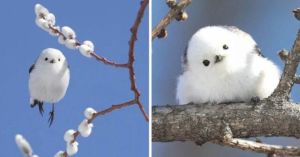
Shima-enaga (Aegithalos caudatus japonicus) belongs to the family of long-tailed suckers, but is distinguished by several traits that make it immediately recognizable. Where its Eurasian cousins wear a well-marked dark eyebrow, the shima-enaga has an entirely white face, without an eye stripe. This particularity, acquired through his island isolation, gives him this sweet and almost astonished expression that conquered the photographers.
Its silhouette hardly exceeds thirteen to fourteen centimetres, of which almost half for the tail, for a weight of only about eight grams. Suffice to say, it takes some patience to spot it in the vegetation, even when it is near. In winter, his survival strategy is to inflate his plumage to imprison a layer of insulating air, which turns him into a little ball of almost perfect white down. At night, members of the same group huddle against each other to share their warmth.
This ability to withstand the winters of Hokkaido, where the minimums regularly descend around five degrees in January, forces respect. Especially as the bird remains active all day long, constantly flirting in search of insects and larvae hidden under the bark.
Where and when to hope to see it
Shima-enaga lives exclusively in Hokkaido, mainly in birch forests and forested areas that cover the island. Contrary to a well-known idea, it is not confined to the deep forests alone: it can be crossed on the edge, in treed urban koen and up to the vicinity of the inhabited areas, as long as the vegetation offers it food and hide.
Winter remains the most emblematic season to observe it, not because it is more abundant, but because the contrast between its white plumage and the denuded branches makes it infinitely more visible. From December to March, the morning outings, when the light is still low and the birds actively seek their food, offer the best chance of encounter. However, it is necessary to deal with often negative temperatures and heavy snow: in Sapporo, the maximums of January revolve around less than one degree.
Summer reveals an almost unrecognizable bird. After moulting, the immaculate whiteness of the shima-enaga is lost: brownish and black feathers appear on the back and wings, and its silhouette refines. It then becomes much more discreet, melting in dense foliage. Warrior observers look for him at dawn, in wetlands and woodlands, but summer encounters remain rare and precious. For travellers who wish to combine observation and discovery of Hokkaido, the period from June to September remains the most comfortable climate, with summer maximums around twenty-five degrees in August.
Understanding the phenomenon
It would be tempting to reduce the shima enaga to its appearance. But his success in Japan is far beyond the circle of birdwatchers. Peluches, key chains, pastries with its effigy, theme hotel rooms: the bird has become a real phenomenon of society, to the point that some establishments dedicate permanent spaces to it. Social networks have amplified the movement, every winter seeing the influx of amateur photographers who come to try the perfect cliché — an exercise far from obvious as the bird is mobile.
This popularity has a counterpart: it draws attention to a bird whose forest habitat remains vulnerable. If the species is not considered threatened at this time, pressure on Hokkaido’s boreal forests and climate change may eventually weaken its populations. Observing the shima-enaga is therefore also a measure of a natural balance that has nothing anecdotal.
Culturally, the bird bears an ainou name,upashichiri, which means “snowbird”. This sonage reminds us that Hokkaido is not only a spectacular destination: it is a land where indigenous knowledge and ecological realities meet. For the French-speaking traveller, an interest in Shima-enaga opens a discreet door to this dimension, without ever falling into folklore.
Preparing an observation exit
The observation of the shima-enaga is not entirely improvised. The bird is curious but lively, and its rapid flight makes it difficult to keep an eye on. A few simple principles greatly increase the chances of crossing it without disturbing it.
Focus on the first hours of the day, especially in winter when birds have to rebuild their reserves after night. Peri-urban forested areas, wooded koen and river banks are more accessible research sites than deep forests, especially if personal vehicles are not available. In Sapporo, the Maruyama Koen and the outskirts of the Toyohira River are areas regularly frequented by local observers, but without guarantee: nature retains its rights.
On the equipment side, a pair of binoculars remains indispensable, even basic. Clothing must be adapted to cold conditions, with superimposed layers and waterproof footwear. It is also recommended to stay at a reasonable distance from groups, never feed birds and limit noise. Shima-enaga is not to the point of being approached, but disturbing it during a period of intense cold can compromise its energy survival.
Finally, we must accept uncertainty. Even in the best areas, an exit can lead to a simple walk in the snow. Travelers who approach observation with this humility often leave with the most beautiful memories — not necessarily a photo, but a suspended moment.
The Shima-enaga, revealing an intimate Hokkaido
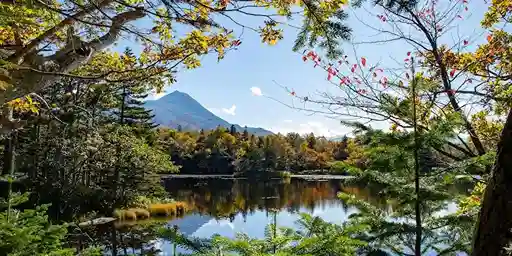
What strikes is the way in which it slows down. Hokkaido is an island of large spaces, wide landscapes, endless roads. The bird, on the other hand, imposes a tiny scale: a few meters of branches, a soft trunk, a net of free water between two plates of ice. We don’t travel the area anymore, we live there.
This experience joins a certain Japanese tradition of nature observation, where attentive eyes and patience count as much as the spectacle itself. It also recalls that tourism in Hokkaido is not limited to the ski resorts of Niseko or the lavender fields of Furano. There is a more discreet Hokkaido, that of winter undergrowth and silent mornings, where the presence of an eight-gram bird suffices to justify the displacement.
For travellers planning a trip to northern Japan, including a half-day observation of the Shima enaga on a wider route — between Sapporo, Otaru and the hot springs of Noboribetsu, for example — makes it possible to vary the pleasures and get off the most frequented trails. Public transport serves the outskirts of peri-urban forested areas properly, and a local guide can greatly facilitate research while providing valuable insight into the ecology of the island.
Shima-enaga is not a trophy to check on a list. It is a bird that deserves, after an often silent and cold wait, and leaves to those who have seen it something other than a simple image: the feeling of having seen, the space of a moment, a form of grace peculiar to the winters of Hokkaido. If you are planning a trip to northern Japan and wish to integrate an observation exit with your itinerary, please feel free to contact us to build a program adapted to your pace and season.
If this article has brought you useful information and can help other travellers prepare for their stay, a Google review will always be appreciated. |
|
Frequently Asked Questions about Shima-enaga
How many days does it take to hope to see a Shima-enaga in Hokkaido?
Count at least two to three days on site for a reasonable chance, targeting forested areas around Sapporo or Asahikawa. A single morning exit is not usually enough: the bird is mobile and weather conditions play a decisive role. Four to five days alternate several sectors and increase probability while discovering the region. After a week, you can combine winter observation and discovery of other natural sites in Hokkaido, such as hot springs or frozen lakes.
What is the best time to observe the Shima-enaga?
From December to March, when its white plumage contrasts with the bare branches and snow. The temperatures are low — around five degrees at night in Sapporo in January — but the birds are active during the day. The summer, from June to September, offers a milder climate but the bird is much more discreet, with a brown plumage that camouflages it in the foliage. If your priority is observation, focus on winter; If you travel with your family and fear the cold, summer is still possible but encounters will be rarer.
How much is a day spent observing the shima enaga?
Apart from transportation costs, a day of observation does not require a specific entry ticket: Koen and peri-urban forested areas are generally accessible free of charge. Count about 1,000 to 1,500 yen for a day of public transport in Sapporo, or 6,000 to 8,000 yen for car rental if you want to reach more isolated areas. A local naturalist guide, if you hire one, represents a budget of 15,000 to 25,000 yen for half a day. In total, a reasonable day of observation remains below 10,000 yen per person without accommodation.
How do I travel to search for the shima enaga without ruining himself?
Hokkaido’s public transport network is uneven by sector. Around Sapporo, the metro and buses serve several wooded koen for a rate of 210 to 250 yen per journey. For more remote areas, the car is often indispensable: 5,000 to 7,000 yen a day for a small cylinder capacity, without fuel. Regional JR Passes are not profitable for local research, but the Hokkaido Rail Pass in 5 days at 22,000 yen can be justified if you combine observation and travel between several cities.
What culinary specialties to taste during a stay in Hokkaido?
Hokkaido is renowned for its dairy products, seafood and fruits. A seasonal sashimi plate in a local market costs between 1,500 and 3,000 yen. Sapporo’s ramen, with miso broth and butter, revolves around 900 to 1,200 yen. Don’t miss Yubari’s melon in summer, sold individually in fine grocery stores for 2,000 to 5,000 yen per caliber. In winter, dairy products — cheeses, ice creams, pastries — are a safe value, with prices comparable to those of large Japanese cities.
What to do in Hokkaido when it rains or the cold is too intense?
Days of bad weather are frequent in winter. The Sapporo Beer Museum, Hokkaido Historical Museum and Noboribetsu Aquarium offer cultural or family alternatives for 500 to 2,000 yen entrance. In Sapporo, the department stores and underground passages allow you to move in the warm for several kilometres. For bird lovers, some observation cafés near Chitose offer heated windows overlooking the feeding areas, with a budget of 1,000 to 2,000 yen for consumption and access to the room.
Discover more from Evasions Rebelles - Travel Planner Japon
Subscribe to get the latest posts sent to your email.