TheSokushinbutsu“Buddhas in their lifetime” refers to mummified monks in Japan, mainly from the esoteric currents of Buddhism such as Shingon. This unique, complex practice, surrounded by deep beliefs, is unique to certain parts of Japan, particularly in northern Honshū Island. Much more than a marginal religious phenomenon,Sokushinbutsuembody extreme spiritual aspirations mixed with local traditions and historical struggles.
Origin and meaning of the term sokushinbutsu
The wordSokushinbutsuliterally means “to become a Buddha in his current body”. It refers to an ideal of esoteric Buddhism where one reaches the Buddha state without going through classical death and reincarnation. This belief is based on the idea that the body of the practitioner can be so sanctified that he himself becomes a living relic.
In most Japanese cases, this has been translated into voluntary mummification, undertaken during his lifetime, after an extremely rigorous asceticism. The monk’s body is then preserved and exposed, considered not as a corpse, but as an awakened being in eternal meditation, waiting for Buddha Maitreya.
Location and regional importance
The majority ofSokushinbutsuare located in the Shōnai region of northern Yamagata Prefecture. The temples of Dainichibō ( These temples belong to a branch of Shingon Buddhism strongly rooted in mountain worship, especially around Mount Yudono (
The absence of this practice in other religious centres, such as Mount Haguro, is evidence of a historical divide between different religious schools, particularly those affiliated with the Tendai tradition and those of the esoteric Shingon.
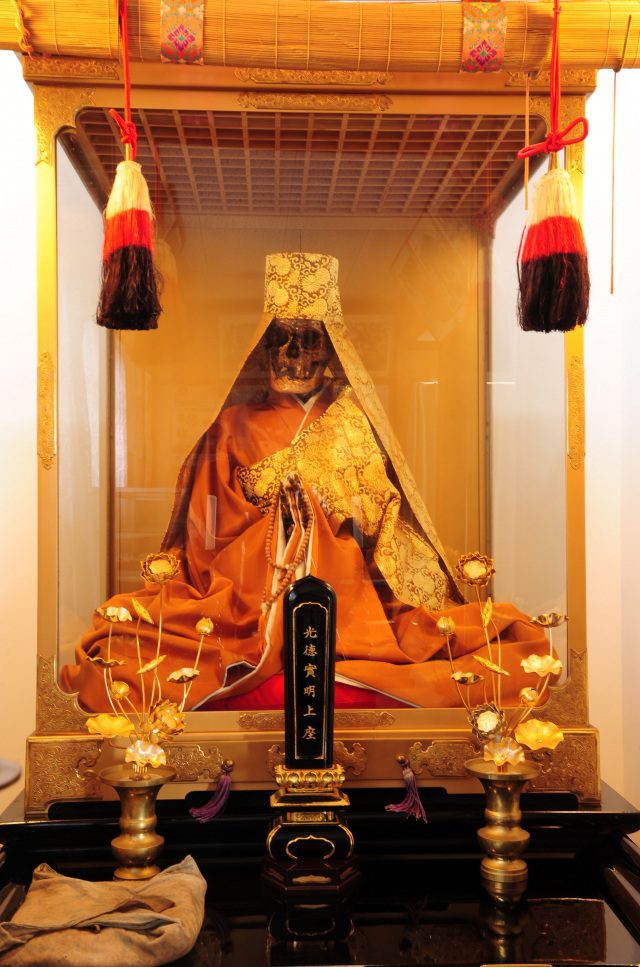
The Dainichibō temple houses the mummy of Shinnyokai-shonin, a monk having reached the state of Sokushinbutsu. This place is particularly steeped in history, as it was one of the three main temples of Mount Yudono that resisted the forced conversion of the mountain to Shintoism in 1869. Other mummies of Sokushinbutsu monks can also be observed in the temples of Chūrenji, Honmyōji and Nangakuji, testifying to an extreme spiritual practice peculiar to the ascetic tradition of Shugendō in this northern region of Japan.
List and Map of Sokushinbutsu
The Sokushinbutsu Process: Extreme Asceticism
The way to theSokushinbutsudoes not start with death, but with a spiritual training calledmokujikigyōliterally “the practice of eating trees.” For several years, the monk renounces all ordinary food, including cereals, and feeds exclusively on nuts, bark, roots and pine needles.
This extreme diet results in a drastic reduction in fat mass and progressive dehydration of the body, reducing the chances of decomposition after death. Some sources also mention the consumption of tea based on lacquer sap (urushi), toxic to insects and the organism, contributing to natural embalming.
Once the body is sufficiently “prepared”, the monk enters an underground isolation chamber in a lotus position, sometimes in a space barely wider than his own body. He meditates to death. A small bell allowed him to report daily that he was still alive. When the bell stops ringing, the cell is sealed. After several years, the body is exhumed. If the mummification is successful, the monk is declaredSokushinbutsu.
Doctrinal distinctions and spiritual motivations
TheSokushinbutsudoes not arise from a single spiritual current. Two great visions can be distinguished:
- Waiting for Maitreya: some monks, influenced by theMilukububosatsu() choose to remain in a meditative state until the advent of this future Buddha, supposed to descend to Earth in several billions of years. This thinking refers to the notion ofnyūjō“Entry into eternal meditation”.
- Union with Dainichi NyoraiOthers aspire to fusion with the cosmic Buddha Dainichi, the central figure of Shingon Buddhism. Here, mummification is not the objective, but a physical consequence of a state of enlightenment reached during their lifetime.
These doctrines are not always exclusive. Some monks, like Shūkai Shōnin, express in their writings a combination of the two perspectives.
The social and political dimension
The history ofSokushinbutsuis not only religious. In the social system of Yudono, the monks calledgyōninThese were from the poorest social strata. BecomeSokushinbutsuFor them it was a way to raise spiritually but also to acquire posthumous prestige, in a context where few other ways of social recognition were open to them.
In addition, in the Edo era, some temples used theSokushinbutsuas evidence of doctrinal legitimacy in the face of rival temples, particularly in the context of conflicts with the authorities of Mount Haguro. There have even been trials to resolve disputes between religious branches.
Scientific studies and conservation
From the second half of the 20th century, multidisciplinary research was conducted on these Japanese mummies. The Japanese Mummy Research Group (Nihon Miira Kenkyū Gurūpu) conducted anatomopathological, anthropological, historical and religious studies.
The analyses provided a better understanding of auto-momification techniques and authenticating certain mummies. However, many of them are now fragile, damaged by time, insects or manipulation. Preservation is often based on the limited resources of temples.
Illegal and prohibited practice today
The practice ofSokushinbutsuis now illegal in Japan. It is treated as a form of assisted suicide or as an unlawful manipulation of corpses under Japanese criminal law. The monks exposed are therefore exclusively historical figures, venerated but not reproduced.
emblematic cases
Among the best known figures:
- Kōchi Hōin, considered as the first to have enterednyūjōwith declared intention to wait for Maitreya.
- Honmyōkai Shōnin (本, mummified after the trials between Yudono and Haguro, testifying to a marked political context.
- Shūkai Shōnin, whose writings reflect a hybrid thought between Maitreya’s expectation and the realization of Buddha’s state through meditation.
Even today, these figures arouse fascination, respect and debate at the border of the religious, cultural and scientific. Their visit to the temples of northern Honshū offers rare insight into the most extreme forms of the Japanese Buddhist faith. Understanding the sokushinbutsu is to explore an unknown facet of Japanese spirituality and its relation to the body, death and awakening.
If this article has brought you useful information and can help other travellers prepare for their stay, a Google review will always be appreciated. |
|

Learn more about preparing your trip to Japan
Discover more from Evasions Rebelles - Travel Planner Japon
Subscribe to get the latest posts sent to your email.