The taiko, an iconic drum of Japan, is not a mere percussion instrument. At the crossroads of music, choreography, spirituality and martial art, his practice is also a powerful form of body expression, deeply rooted in Japanese culture. Enjoyed today throughout the world, Taiko draws its roots in centuries of history. This article proposes to understand the origins, uses, techniques, and possibilities offered to travellers who wish to discover or practice this art during a stay in Japan.

History and origins of Taiko in Japan
The term “taiko” ( Within the country, the term “wadaiko” is used more precisely as the “Japanese drum”. The first representations of taiko date back to the Kofun era, these 6th-century tumulus graves decorated with Haniwa figures. From that time on, the drums had already held a ceremonial function.
The arrival of musical instruments from the Korean peninsula and China between the 5th and 7th centuries marks a turning point. The Taiko finds its place in the great religious ceremonies, especially during the opening of the eyes of the Buddha statue in Nara in 752.
Over the centuries, the instrument integrates with the major artistic forms of Japan: theatre no in the Middle Ages, kabuki in the Edo era. It is also used in Buddhist temples and traditional festivals. Its role goes beyond music: Taiko becomes a tool for spiritual and social communication.
Taiko Contemporary: A Living Art in Japan and the World
The revival of Taiko began in the 1950s-60s, with the appearance of the first modern ensembles. This style, calledkumi-daiko, is based on the coordination of several types of drums. The Kodō group, founded in 1981 on Sado Island, played a crucial role in the popularization of Taiko in Japan and internationally. Their approach is based on rigorous practice, combining music, movement, body anchoring and mental discipline.
Today, taiko is practiced worldwide: the United States, South America, Europe and South-East Asia. In France, about ten groups are active, notably in Paris, Lyon and Toulouse. Concerts often integrate into Japanese festivals or cultural events. Some groups also offer workshops and training.
Structure and manufacture of taikos
A taiko drum consists of several fundamental elements:
- The dō (: the resonance box, usually in solid wood such as keyaki (Japanese zelkova), or sometimes in laminated wood for more affordable versions.
- Kawa: the skin of the drum, traditionally made of cow leather, stretched and fixed by decorative nails (byō) or ropes.
- The bacci (: baguettes, made in different woods (chêne, cypress, magnolia, maple), chosen according to the type of sound sought and the size of the drum.
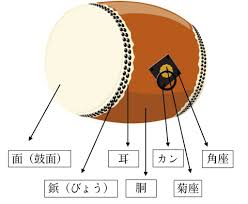
The manufacture of a taiko is a long and meticulous process, often entrusted to skilled craftsmen.
Types of taikos and their functions
There is a wide variety of taikos, adapted to different contexts:
- Odaiko: the largest, spectacular, used to impress in concerts.
- Nagado-daiko: long drum drum, often seen in festivals.
- Shime-daiko: small drum stretched by strings, with a more sharp sound, often used to mark the rhythm.
- Hira-daiko (: flat drum, used in certain religious ceremonies.
Each type has its specificities in terms of sound, posture and role in a whole.
Game technique and posture
Playing taiko requires total body involvement. The musician adopts a stable and anchored posture, bent knees, right back, in order to optimize the power and precision of the strikes. The arms move in coordination with the centre of the body, in a fluid and controlled movement.
Strikes are made in a vertical plane, using body weight and gravity. This is less about gross force than about energy concentration and transmission. The player also learns to synchronize his actions with those of others, in a search for collective harmony.
Some styles also incorporate voice, by rhythmic cries (similar to the martial arts kiai) or songs used to memorize sequences. This contributes to group cohesion and the intensity of interpretation.
Taiko and the spiritual dimension
Beyond musical performance, taiko is often seen as a personal development practice. Its rigor, its physical and mental requirement make it a path close to the budō (martial way). The repetition, the search for a perfect gesture, the mastery of the breath and the attention given to each strike create a meditative space.
This dimension is found in temples where taiko is played to rhythm rituals. On the island of Sado, members of Kodō follow a monastic routine of meditation, physical training, silence, and instrumental practice.

Where to discover or practice Taiko during a trip to Japan
For travellers interested in Japanese music culture, there are several possibilities for them:
- Attend a show: ensembles like Kodō or Drum Tao offer tours in Japan, with performances in large theatres or at festivals.
- Participate in a workshopIn Tokyo, Kyoto, Osaka or even on the island of Sado, groups or schools offer initiations, accessible to beginners. The sessions usually include a presentation of the instrument, posture exercises, and learning a simple piece.
- Visit a manufacturing workshopSome artisans accept visits by appointment. It is an opportunity to discover the ancient manufacturing techniques and learn more about the choice of materials.
- Explore a matsuri (festival)During local holidays, taiko performances can often be seen, especially during tank parades or at the opening of ceremonies.
To organize these experiences, using a travel planner specialized in Japan can be a real asset. It will be able to recommend suitable places according to the period of stay, the desired level of practice and geographical accessibility.
Why Taiko fascinates so much
The success of taiko around the world is explained by several factors: the power of sound, the beauty of movements, the synchronization between players, but also the emotional burden of this art. Whether played in a temple, on a stage or in a rehearsal room, the taiko captive by its intensity.
This practice brings together music, breath, posture, voice, rhythm, listening, strength and precision. It is intended not only for those who want to “play drums”, but for anyone curious to discover a complete art, living and deeply rooted in Japanese culture.
For lovers of cultural travel, body music or meditative practices, taiko is a fascinating gateway to another way of understanding Japan.
If this article has brought you useful information and can help other travellers prepare for their stay, a Google review will always be appreciated. |
|
Discover more from Evasions Rebelles - Travel Planner Japon
Subscribe to get the latest posts sent to your email.