The oiran, often called “first flowers”, were Japan’s highest courtesan during the Edo era. More than mere figures of pleasure, they were recognized for their culture, refinement and role in the art of living of ancient Japan. Today, their memory persists in festivals, fashion and collective imagination. Understanding who they were allows us to better grasp an essential facet of Japanese cultural history.
Origins and meaning of the term
The word “oran” comes from the popular expression “ora no tokoro no nюsan”, meaning “the great sister of our house”. The characters used, flower ( Before the appearance of the term oran, the word tayū already referred to the most prestigious courtesans, masters in refined arts such as dance, singing and poetry. In time, tayū remained associated with Kyoto and Osaka, while the term oran became emblematic of Yoshiwara’s pleasure district in Edo.
The universe of neighborhoods of pleasure
The Iran lived in enclosed areas called yūkaku, real cities surrounded by walls and governed by strict rules. Yoshiwara in Edo, Shimabara in Kyoto and Shinmachi in Osaka became the most famous places. These neighbourhoods concentrated not only closed houses, but also theatres, restaurants and theatres, creating a parallel world where hierarchy and labeling imposed a precise protocol. Customers had to be recommended and often wait several visits before being accepted by a high-ranking oran.
A demanding education
Unlike ordinary prostitutes, the orans were trained from their youth in reading, writing, classical arts and rules of politeness inspired by the imperial court. The young apprentices, called kamuro, accompanied their eldest by observing her actions, serving small tasks and permeating refined language codes. Learning included mastering shamisen, koto or shakuhachi flute, as well as l The eloquence and poetry were such essential assets as beauty.
The prestige and hierarchy
Iran occupied a high place in the urban society of Edo. The most famous, often in the tayū range, received their clients in sumptuous decorations reminiscent of aristocratic palaces, decorated with fine screens and paintings. They had the privilege of choosing or refusing their visitors, which strengthened their aura. The tariffs were exorbitant, sometimes equivalent to the annual income of a merchant. Their influence exceeded the intimate sphere: they inspired fashion, dictated dress trends and played a role in the dissemination of aesthetic codes.
Spectacular parades
A symbol of their status, the oiran walked in processes called oran dōchū. Accompanied by their kamuro, they advanced 20 cm high geta pavements, performing a complex eight-walk, the hachimonji. Their richly decorated kimono, composed of multiple layers weighing up to twenty kilos, was tied from an obi to the front, a distinctive sign of their rank. These parades attracted crowds and were a key moment to observe new trends in hairstyles, accessories and makeup.
Differences with geishas
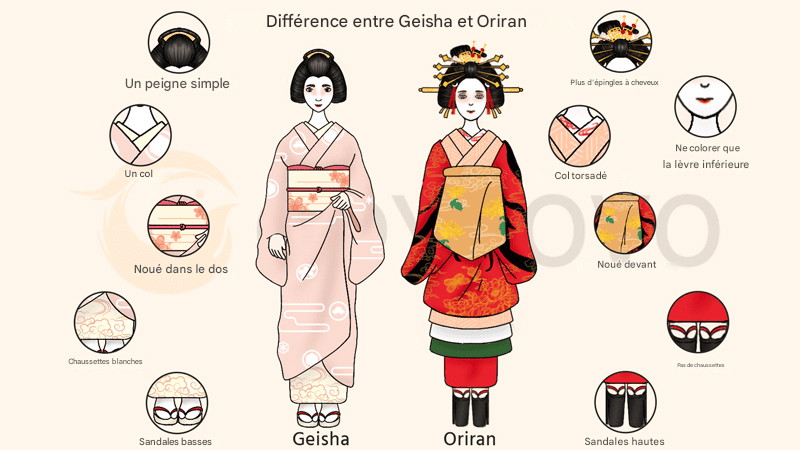
Irans and geishas are often confused, but their roles differed greatly. Geishas, entertainment artists, focused on music, dance and conversation, with no direct connection to sexuality. They were accessible to a wider clientele, while orans, high-ranking courtesans, combined intimacy and cultural refinement. Over time, the simplicity and affordability of geishas contributed to their success, marking the gradual decline of the oran.
The decline of the oran
Over the course of the 19th century, the gap between the frozen life of the neighborhoods of pleasure and the evolution of Japanese society intensified. The orans, locked in strict codes, lost their appeal to a population seeking entertainment closer to their daily lives. The rise of geishas, cheaper and more in line with the tastes of the moment, precipitated their disappearance. The laws of 1958 prohibiting prostitution definitively ended their social role, leaving only a few tayū still dedicated to the preservation of traditional arts.
Heritage and contemporary survival
Today, the orans belong to history, but their image remains present in popular culture and festivals. Reconstituted parades, such as the Bunsui Oiran dōchū in Niigata or the parades of the Kannon temple in Nagoya, make it possible to relive the brilliance of these processions of the Dantan. Their aesthetics still influence fashion, photography and visual arts, while mangas, films and animes incorporate them into their narratives. In some historical quarters, it is possible to experience a photo shoot in d’oiran costume, a testimony of a persistent fascination for this refined universe.
The iran, figures both admired and constrained, represent a unique facet of Japanese history. Their heritage, combining art, elegance and social hierarchy, continues to fascinate beyond their disappearance. Travelling to Japan also means meeting these echoes of the past in festivals, museums or popular culture, and understanding that behind the fascist was a codified and demanding life.
If this article has brought you useful information and can help other travellers prepare for their stay, a Google review will always be appreciated. |
|
Discover more from Evasions Rebelles - Travel Planner Japon
Subscribe to get the latest posts sent to your email.