Fushimi Inari Taisha Shrine, located south of Kyoto, is one of the most photographed and visited sites in Japan. It is famous for its thousands of vermilion torii that form tunnels on the trails of Mount Inari, a 233-metre-high sacred wood. But behind the image of Epinal is an ancient place of worship, dedicated to Inari, god of rice and prosperity, where kitsune serve as messengers and where each door bears the name of a donor. The visit can be limited to a one-hour walk in the densest tunnels, or turn into a three-hour hike to the summit, with views of Kyoto and an atmosphere that changes as you climb. Here is how best to prepare this experience, from access to trails, through rituals and gourmet stops.

Inari, kitsune and the origin of the sanctuary
Fushimi Inari Taisha is the main sanctuary of a network of thousands of shrines dedicated to Inari, the Shintoian divinity of rice, agriculture, trade and prosperity. Its origin dates back to a period prior to the transfer of the capital to Kyoto in 794, making it one of the oldest places of worship in the region. The sanctuary was originally installed on Mount Inari, which still belongs to its sacred lands. Over the centuries, it has become a major place of pilgrimage, frequented by the merchants, artisans and inhabitants of Kyoto who came to ask for Inari’s protection for their activities.
Kitsune, or foxes in French, are the messengers of Inari in the Shinto tradition. There are many statues in the sanctuary, often represented with a key in the mouth, symbol of the key to the rice attic in ancient times. Some statues hold a jewel or scroll, attributes of wisdom and knowledge. Kitsune are not deities themselves, but intermediaries between humans and Inari, and their presence reminds us that the sanctuary is above all a place of mediation between the visible world and the spiritual world.
The sanctuary has been rebuilt several times in the course of fires and wars. The current main building, theHonden, date of 1499, and the large entrance gate, therōmonwas offered in 1589 by Toyotomi Hideyoshi, one of Japan’s leading unifiers. Behind therōmonthere is the prayer room,Haiden, where visitors throw a room into the trunk before bowing and hitting in their hands to attract the attention of the divinity. These simple gestures are at the heart of the daily practice of the sanctuary.
Torii and Senbon Torii
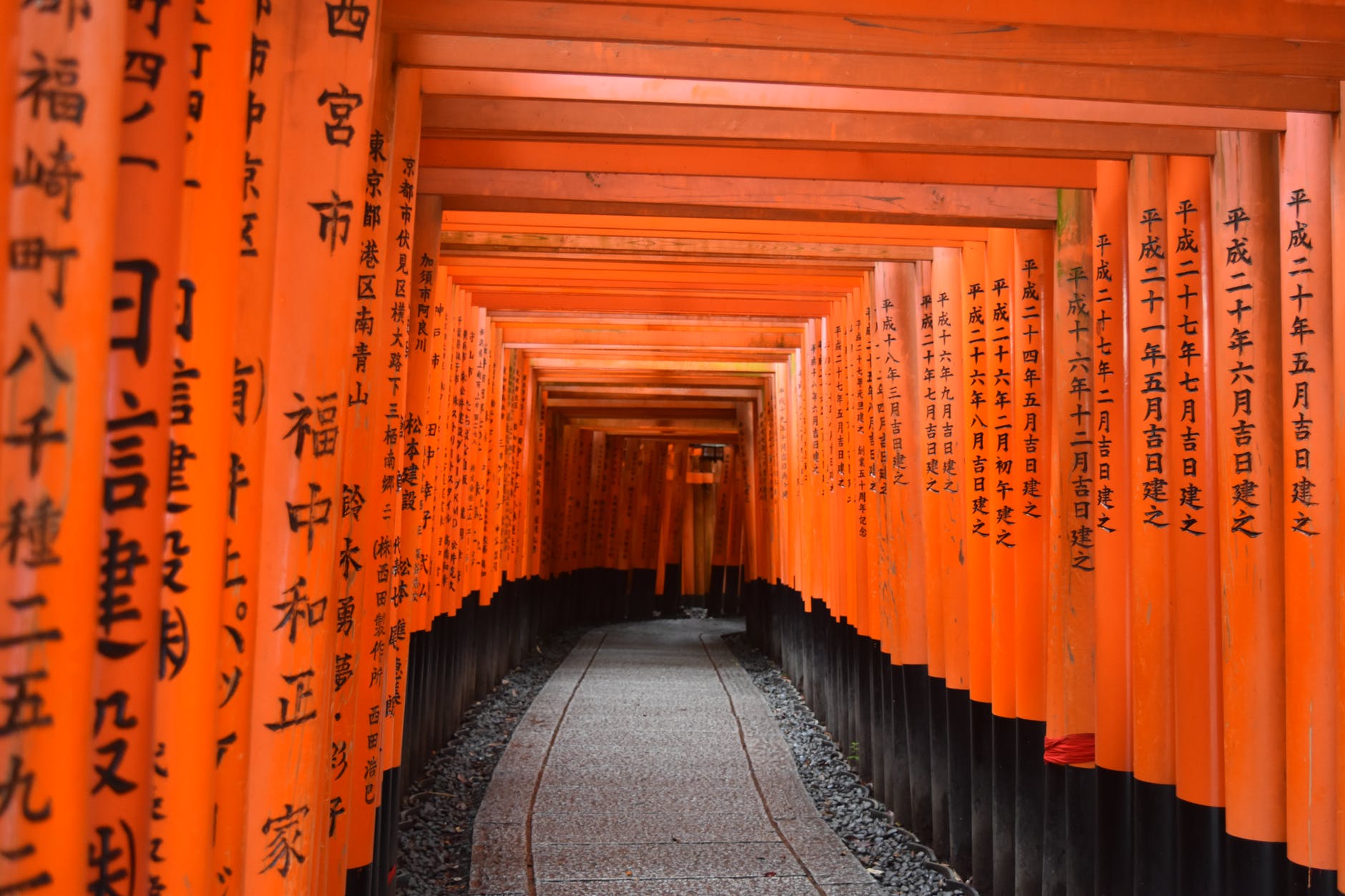
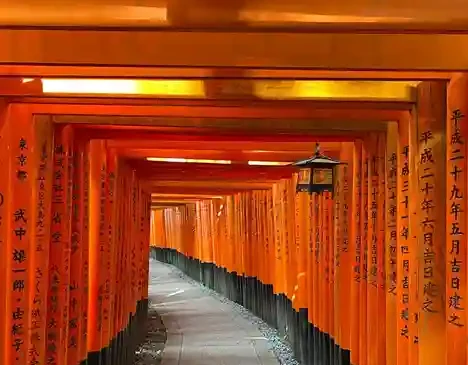
Tori are Shinto portals that mark the passage from the secular world to the sacred world. At Fushimi Inari, thousands of them border the trails of Mount Inari, forming vermilion tunnels that have become the emblematic image of the sanctuary. Each tori is a gift from an individual or business, and the name of the donor, the date of the donation and sometimes a short registration can be read in the back. Small torii cost about 400,000 yen, while larger torii cost more than 1 million yen. Donations are then used to maintain the sanctuary and trails.

TheSenbon Torii, or “1,000 torii”, is the most famous section of the sanctuary. These are two parallel, dense rows of porches that go up to the inner sanctuary. This section is often very popular, especially in the mid-morning and early afternoon, and sometimes you have to wait to take a photo without passers-by. To avoid crowds, it is advisable to come early in the morning, before 8 a.m., or late afternoon, after 4 p.m. The contrast between the vermilion colour of the torii and the greenery of the forest is particularly striking under the shaving light of the morning or evening.
The torii are not only decorative. They materialize the path of the pilgrim, who progresses from sanctuary to sanctuary, increasingly high on the mountain. Each tori marks a step, a gift, an intention. By crossing them, one advances into a space both physical and symbolic, where landscape and devotion mingle. The oldest tori bear the traces of time, with their erased inscriptions and patinated wood, while the most recent ones shine with a brilliant vermilion.
The main sanctuary and its rituals
The main sanctuary, orHaidenis the spiritual heart of Fushimi Inari. Visitors come there to pray, make a vow or thank Inari for a favor obtained. The ritual is simple: one throws a piece into the trunk, shakes the rope attached to a bell to attract the attention of the divinity, then bows twice, strikes twice in his hands and bows one last time. This gesture, repeated by thousands of people every day, creates a particular atmosphere, made of sounds of coins, bells and whispers.
Right ofHaidenis a small secondary sanctuary, theHigashimaru-jinja, where students come to pray to pass their exams. There are garlands of a thousand paper cranes, folded by the faithful to make a vow. Traditionally, he who folds a thousand cranes sees his wish fulfilled. The cranes, of all colours, are hung in tight clusters, creating a visual spectacle that is both colorful and moving. Some visitors also depositemaThese little wooden planks on which one writes his wish.
A little further, the office of the sanctuary offersomikuji, makeshift papers that are drawn at random after shaking a cylinder containing numbered sticks. The paper costs 200 yen and indicates whether one is promised a great chance, a moderate chance or bad luck. If the omen is bad, it can be attached to a support provided for this purpose, so that the wind carries the bad spell. Theomikujiare a popular ritual, practiced by Japanese of all ages, and they add a touch of play to the visit.
The course and its stages
The hike to the top of Mount Inari and return takes about two to three hours, according to the rhythm and stops. The trail is well marked, with shady steps and passages, but it has steep portions and irregular stairs. It is advisable to wear good shoes and carry water, especially in summer. The route is marked by small shrines, tea houses and views, allowing you to split the climb and enjoy the landscape.
AfterSenbon Torii, the path continues to the inner sanctuary, then to a series of secondary shrines. The first notable stop is theShin-ike, a small pond lined with torii, where you can take a break. Then comes the crossroads ofMitsu-tsuji, where the path divides. You have to take a right to continue towards the top. The torii become less dense as you climb, but the frame remains woody and peaceful, with views of the valley.
The trail passes through several secondary shrines, including theShimo-no-Yashiro,Naka-no-YashiroandKami-no-Yashirowhich marks the summit. Each of these shrines has its own atmosphere, with its kitsune statues, small torii and offerings. Some are very frequented, others more discreet, but all bear witness to the popular devotion that surrounds Inari. The tea houses, scattered along the route, offer drinks and simple dishes, such as theinari sushiandkitsone udon, both based on fried tofu, known as the kitsune’s favorite food.
Yotsutsuji’s viewpoint
The crossroads ofYotsutsuji, located halfway up the mountain, is one of the highlights of the hike. It is accessed after about thirty to forty-five minutes of climb from the main sanctuary. The place offers a clear view of the south of Kyoto, with its houses, temples and, in clear weather, the hills surrounding the city. Two tea houses offer drinks and snacks, making it an ideal place for a break.
Many visitors stop atYotsutsujiand then come down again, as the continuation of the course is longer and less spectacular in terms of torii density. This is a reasonable choice if you have little time or if you want to avoid a more demanding climb. However, those who continue to the top discover more intimate secondary shrines and less frequented viewpoints, with a more contemplative atmosphere.
The summit and secondary shrines
The summit of Mount Inari, 233 metres away, is crowned by the sanctuaryKami-no-Yashiro. It is a modest place, but full of significance for pilgrims who have climbed the paths. There are statues of kitsune, torii and offerings, in a peaceful setting surrounded by trees. The summit does not offer a panoramic view, because the vegetation is dense, but the atmosphere is particular, more collected than on the main trails.
As the path descends, it passes through other shrines, such as theMitsurugiyaandYakurikisha, where there is a small waterfall used by the faithful for ritual ablutions. The route forms a loop that returns to the main sanctuary in about an hour’s walk. It is important to follow the signs, as some branches can be confusing, especially around theGozen-dani, where the path is divided between several routes.
The descent offers different perspectives on the torii and the forest, with a light that changes throughout the day. At the end of the afternoon, the sun’s rays cross the porticoes and create particularly photogenic shade and colour. It is also the time when the number of visitors is decreasing, which allows you to enjoy the trails more quietly.
How to reach Fushimi Inari
Fushimi Inari Taisha is a few minutes from Kyoto Train Station. The simplest way is to take the JR Nara line to the Inari station, which is right in front of the entrance to the sanctuary. The trip takes about five minutes and costs 150 yen. Another option is the Keihan line, with the train station of Fushimi Inari, located a few minutes walk from the sanctuary. Both accesses are well indicated and easy to find.
From the Inari station, you just have to cross the street and follow the flow of visitors to the large entrance torii. The approach is impressive, with the vermillon portals standing in front of you and the kitsune statues that border the way. From the train station of Fushimi Inari, on the Keihan line, the journey is also short, with a few minutes walk through a quiet residential area.
Schedules, rates and good periods
The sanctuary is open daily, without interruption, and the entrance is free. There are no opening or closing times, which allows you to come early morning or evening, when the crowd is less dense. The mountain trails are permanently accessible, but it is advisable not to engage after dark, as the lighting is limited and the steps can be slippery.
The best time to visit depends on what we are looking for. Spring and autumn provide pleasant temperatures, but frequentation is high, especially during the season of cherry blossoms and autumn colours. The summer is warm and humid, but the mornings remain bearable. The winter is quieter, with clear days and a sometimes hazy atmosphere that gives the torii a special aura. Whatever the season, it is recommended to come early in the morning, before 8 a.m., to enjoy the trails in peace.
The specialties to taste on site
The tea houses on Mount Inari offer simple and comforting specialties, often linked to the symbolism of the fox. Theinari sushi, composed of wine rice wrapped in a tofu bag fried, is a classic. Thekitsone udon, a noodle soup with fried tofu, is also popular. These dishes take their name from the kitsune, because fried tofu would be his favorite food. Prices vary from 500 to 1,000 yen depending on the servings and tea houses.
At the entrance to the sanctuary, several stalls sell snacks and drinks, including matcha ice cream, senbei and hot drinks. Some also proposeomikujiAnd amulets. For a more consistent meal, you have to go down to Kyoto station or explore the Fushimi district, known for its sake breweries and traditional restaurants. The nearby Fushimi district deserves a visit to its historic streets and sake cellars.
Fushimi Inari Taisha is more than just a postcard decor. It is a living place of faith, where torii are gifts, kitsone of messengers and paths of pilgrimage paths. Whether you’re coming for an hour’s walk in the vermillon tunnels or for a three-hour hike to the top, the experience is different but always striking. On leaving, we keep in mind the image of the portals that are chained, the sound of the bells and the rooms, and this impression of having crossed a space both physical and spiritual, where nature and devotion respond.
If this article has brought you useful information and can help other travellers prepare for their stay, a Google review will always be appreciated. |
|
Frequently Asked Questions
How long does it take to visit Fushimi Inari Taisha?
It takes an hour to an hour and a half to see the main sanctuary, Senbon Torii and Yotsutsuji’s gazebo. If you want to go on a full hike to the summit and come back, plan two to three hours, with breaks. The climb is progressive and accessible to medium level walkers, but it has irregular stairs. The sanctuary is open at all times and the entrance is free, which allows you to adapt the duration according to your schedule.
What is the best time to avoid the crowd at Fushimi Inari?
The best time is early morning, before 8 a.m., or late afternoon, after 4 p.m. Attendance is maximum between 10 a.m. and 3 p.m., especially during school holidays and periods of heavy tourist traffic. Weekdays are generally quieter than weekends. If you want to photograph the Senbon Torii without passers-by, you must come to the opening or accept to wait a few minutes. The climb to the top also allows to move away from the densest groups.
How much is Fushimi Inari Taisha’s visit?
The entrance to the sanctuary is completely free, including for hiking on Mount Inari. The main cost is transport: 150 yen for a train journey from Kyoto station to Inari, on the JR Nara line. If you take the Keihan line, the rate is comparable. On the spot,omikujicost 200 yen, amulets between 500 and 1,000 yen, and dishes in tea houses between 500 and 1,000 yen. A complete visit therefore amounts to less than 1,500 yen per person, excluding transport.
Can we see some kits at Fushimi Inari Taisha?
Yes, kitsune are omnipresent in the form of statues. They are found at the entrance to the sanctuary, along the paths and in front of the secondary shrines. Some statues hold a key in the mouth, symbol of the rice attic key, others carry a jewel or a roll. Kitsunes are not deities but messengers of Inari, and their presence recalls the role of the sanctuary as a place of mediation between humans and the spiritual world. Visitors can buy amulets at the kitsune office.
Is hiking to the top difficult?
Hiking is of moderate difficulty. The trail has stairways, steep portions and irregular passages, but is well marked and shaded. The climb to the top takes about an hour to an hour and a half, according to the rhythm, and the descent about an hour. It is advisable to wear good shoes, carry water and provide breaks. People with reduced mobility or less accustomed to walking can be limited to Senbon Torii and the Yotsutsuji lookout, which already offer a rich experience.
What can we eat in Fushimi Inari Taisha?
The tea houses of Mount Inari offer simple specialties, such as theinari sushi(wine rice in a tofu bag fried) and thekitsone udon(soup of noodles with fried tofu), for 500 to 1,000 yen. These dishes are associated with kitsune, whose fried tofu would be the preferred food. At the entrance to the sanctuary, stalls sell ice cream at the matcha, senbei and drinks. For a more complete meal, you must go to the Fushimi district, known for its restaurants and sake breweries.
Discover more from Evasions Rebelles - Travel Planner Japon
Subscribe to get the latest posts sent to your email.