Nestled in the mountainous area of Izu, a few minutes from Shuzenji Train Station, the Gokurakuen Museum offers a rare and striking immersion in Japanese Buddhist beliefs related to the Hereafter. Far from classical tourist tours, this place offers a visual and sound interpretation of the cycle of rebirths, karma and post-mortem worlds according to Buddhist cosmology.

An unusual entrance to the six worlds
The course begins with the reception of a red oni (Japanese ogre) with a large smile, planted at the entrance of a building without pretension. The tone is set: here, the experience is as educational as it is artistic, sometimes confusing, often disturbing. Built in 1986, Gokurakuen is based on a simple idea: to represent the six ways of reincarnation resulting from Buddhist doctrine – the kingdoms of humans, animals, hungry spirits, warlike demons, paradise and hell.
From the first rooms, the visitors are immersed in a sound atmosphere made up of recitations of sutras broadcast continuously. The exhibitions combine models, dioramas, sculptures and dark lights to illustrate the fate of souls according to their past actions. The human kingdom presents itself as a transient place, marked by suffering, but also by the possibility of awakening. Other worlds are more enigmatic, each carrying its own pains or illusions.
The Buddhist Hell, the nerve center of the exhibition
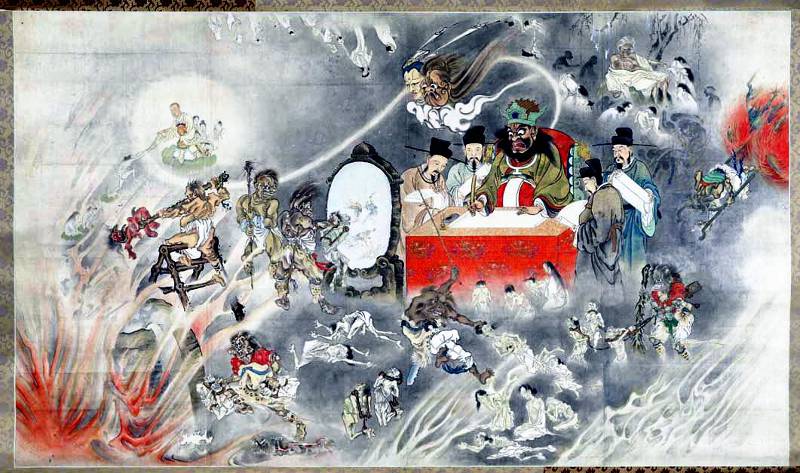
Perhaps the most important part of the museum is the reconstruction of Japanese hell. Inspired by texts such as the Ojōyōshū, this area frontally describes the punishments reserved for those who have committed serious mistakes: treason, violence, lies, selfishness. In a large, dark room, a three-dimensional scene depicts bodies that are begged, dismembered, burned, crushed, tormented by giant oni. Every detail is designed to shock, challenge, and raise awareness of the karmic consequences.
The Japanese believe that hell is composed of eight great levels, each corresponding to a type of fault, and that it is populated by infernal minds charged with enforcing sentences. This visual representation makes it possible to approach a complex and often abstract doctrine in practice. It also illustrates the power of popular beliefs in regulating social behaviour.
A paradise in half-tone
After the dantesque visions of hell, the museum offers a quieter area, called not “heaven” but “heaven”. This part, more modest in area and in staging, symbolizes the state of peace and fullness that virtuous souls can reach. The sobriety of the decor, although voluntary, can leave an impression of abrupt contrast with the visual density of hell. The Buddhist paradise being above all a liberated state of consciousness, its representation here remains suggestive and unloaded.
The adult museum: between curiosity and folklore
On the upper floor, reserved for adults, there is a second exhibition dedicated to carnal pleasures, in the form of a small erotic museum. This section presents an eclectic collection: statues, prints, phallic objects, photographs and scenes of the Japanese Kamasutra. The tone is deliberately humorous, sometimes absurd. Some statues are designed to be interactive, such as that of a male character with the salient attribute supposed to bring luck.
This juxtaposition of the Hereafter and of sexuality, in the same place, can be confusing. Yet it reflects a traditional Japanese approach where Eros and Thanatos, pleasure and death, are seen as two aspects of the same cyclical reality. The use of popular art and caricature also recalls the cathartic function of these objects in Japanese rural societies.
A family craft creation
All the elements exhibited in the museum were made over a period of seven years by the founder of the place and his family, by hand. This long-term work, the result of a strong personal investment, gives the museum a palpable singularity. Unlike a classical museum institution, Gokurakuen has an almost naive artisanal soul where every detail bears witness to a personal relationship to death, karma and transmission.
This family project also reveals another aspect of Japanese popular art, that of educational staging and visualization of myths. The museum is thus part of an ancient tradition of didactic representations from beyond, used by temples to convey moral messages.
Practical information to organize the visit
Gokurakuen is located in Shimofunabara district, in the town of Izu, Shizuoka prefecture. It is accessible from Shuzenji Train Station by taxi or by car (free parking on site). Entry is paid, with differentiated rates according to the sections. The combined ticket (hell + museum for adults) costs about 1,000 yen. Access is prohibited for the under-18s for the erotic part. Allow between 30 minutes and an hour for the full tour.
The museum is open from 10am to 4pm, except on Wednesdays and Thursdays, and can be temporarily closed in case of local events. No card or smartphone payments are accepted on site. There is no restaurant or Wi-Fi. A small boutique space offers souvenirs related to the theme of the beyond, ranging from amulet to figurines inspired by the oni.
Gokurakuen is not a place of worship but a unique cultural site, halfway between folk museum, artistic installation and spiritual satire. For curious travellers of Japanese religious representations and lovers of atypical places, it offers a rare experience, where esotericism becomes tangible.
To visit Gokurakuen is to confront a very incarnate vision of Japanese spirituality. An original way to rethink the notions of fault, merit and life cycle, in a framework that is both disturbing and captivating.
If this article has brought you useful information and can help other travellers prepare for their stay, a Google review will always be appreciated. |
|
Discover more from Evasions Rebelles - Travel Planner Japon
Subscribe to get the latest posts sent to your email.