Nagato is located in Yamaguchi Prefecture, Japan. Rich in nature, the region is full of attractive tourist sites. The surrounding cities are also famous for their tourist sites and some of them are considered the most fascinating sites in Japan. The entire northern coast of Nagato includes Kita-Nagato’s quasi-national park, a protected area with beautiful views of the Japanese Sea.
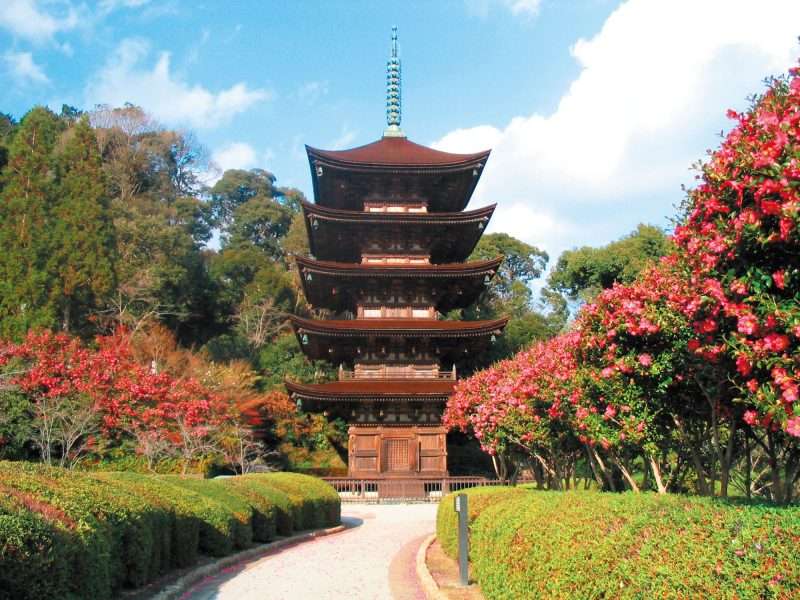
Sanctuary Motonosumi
The Motonosumi sanctuary was selected by CNN Travel as one of the “31 most beautiful places in Japan”. The remarkable location of the sanctuary creates a striking contrast between the red of its doors and the cobalt blue of the waves below.
The sanctuary has a relatively recent history. It was created in 1955 by a man who saw an appearance of a white fox at his bedside and built a sanctuary to appease the gods. Located along the rugged coast in the remote northwestern region of Yamaguchi, the sanctuary is far from the major cities.
Visitors prayed the spirit of the white fox for financial success, success in fishing and safety on the seas. Nowadays, a wide variety of wishes are fulfilled by the fox god, including good fortune and wealth, procreation, marriage, road safety, school success.
An offering box is placed at the top of the highest torii, and it is said that the wishes of those who succeed in throwing their piece into the box will be fulfilled.
Yuya rizieres
Yuya’s terraced rice fields are famous for their magical landscapes on the evenings when sunset illuminates Yuya Bay. The lights of the squid fishery sparkle in the dusk on the surface of the water.
Along the Mukatsuku Peninsula in Nagato, a vast expanse of terraced rice fields covers an area of nearly 700 hectares.
The Dragon’s Spout
An extraordinary spectacle where the waves of the ocean strike the side of the cliff and stand vertically. More impressive in winter, this phenomenon is caused by the winds of the north that project a jet of sea water up to a height of 30 meters, giving the impression that Ryugu, a dragon god living under the sea, threw a large jet of water towards the sky. The history of the underwater dragon has been popular with the inhabitants for many years, and during the droughts many have come here to pray the dragon god to bring down the rain.
Omijima
The island of Omijima is part of the quasi-national park of Kita-Nagato Kaigan, a protected area for its natural beauty.
With about 40 kilometres of breathtaking coastline, steep cliffs and monolithic rocks carved by the ocean that have earned it the nickname of “Sea Alps”, the island of Omijima is a great art exhibition of nature.
(Full article here)
Yasuo Kazuki Museum
This museum houses some of the great works of modern painter Yasuo Kazuki, born in Nagato in 1911, including his “Series Siberia, born from his internment in Siberia after the defeat of Japan during the Second World War. The exhibits at the museum include paintings by the Kazuki family after the painter’s death. The museum also includes a reproduction of the Yasuo workshop and a special exhibition of the personal collection of the painter Picasso and Roualt, takes place three times a year.
Misuzu Kaneko Museum
Dive into the world of poet Misuzu Kaneko. Misuzu Kaneko wrote a total of 512 poems and rhymes during her life, which is documented in this memorial museum built on the site of her childhood home in the centre of Misuzu Road and which also reproduces the bookshop she owned. Discover the universe of Misuzu Kankeo’s poems through the light and sound with the Misuzu Gallery, and imagine the life of this poetess in her time.
Getting to Nagato
From Asa, take the JR Mine Line Nagatoshi (one hour, trains every 1 to 3 hours), then switch to the JR Sanin Line from Nagatoshi to Nagato-Furuichi (10 minutes, trains every 1-2 hours). The entire journey takes about 100 minutes, costs 990 yen one way and is covered by the Japan Rail Pass.
Hagi and Nagato-Furuichi are connected by uncommon trains along the JR Sanin line (about 45 minutes, 680 yen one way, connections every 1 to 4 hours). Most connections require a train transfer to Nagatoshi.
Nagato, whose visit to Omijima can be combined, will be a pleasant two to three days’ visit to the Chugoku and its nature.
Nagato, whose visit we can pairOmijima, will be a pleasant step of two to three days during the visit of theChugokuand its nature.
If this article has brought you useful information and can help other travellers prepare for their stay, a Google review will always be appreciated. |
|
Discover more from Evasions Rebelles - Travel Planner Japon
Subscribe to get the latest posts sent to your email.