The word “geisha” often evokes frozen images, traces of aesthetics and mystery. Yet behind this kimono silhouette is a complex history, marked by social developments, political reforms and subtle distinctions. This article details the emergence of geishas, their role, their transformation over the centuries and the different forms they still take in Japanese culture.
Origins: artists at the margins of power
The ancestor of geisha appeared from the time of Heian (794–185) with theShirabyōshi, women artists dressed as men, who entertain imperial courts and temples with songs and dances. From that time on, artistic performance and the ability to charm an audience by speech became the pillars of this specific social role.

Over time, their place slides from the religious sphere to that of private entertainment. This mutation continued at the time of Edo (1603–1868), when entertainment was structured around the reserved areas, calledyūkaku, like that of Yoshiwara in Edo (current Tokyo).
Emergence of the first geishas: a male function originally
Unlike the current image, the first geishas were men. CalledhōkanortaikomochiThese professional artists were employed in private banquets to entertain guests through music, singing, dance or humour. It was only in the 18th century that women began doing this activity as geisha.

Their success is fast: judged more graceful and versatile than their male counterparts, women eventually dominate this profession. Men still remain in this environment today, albeit marginally.
Separation from prostitutes: a necessary clarification
As soon as they appear, theFemale geishasmust be distinguished fromyūjo, courtesans. The former sell artistic know-how, the latter a sexual performance. This distinction is fundamental in the social organisation of the period, but it is sometimes unclear in practice, especially in areas not regulated as such.“okabasho”from Fukagawa, east of Edo.

One of the major turning points took place in the mid-18th century. In Yoshiwara, in decline, the authorities seek to restore prestige to their establishment. They decide to ban geishas from selling their bodies there and from selling only to the arts. This is the birth of thegeisha officially recognized, professional entertainment, to distinguish from courtesans.
The different types of geishas in Edo: a question of legitimacy
In the Edo era, three types of geishas coexist:
- Thegeishas de Yoshiwara, recognized by the Shogunate, framed and limited to this neighborhood.
- Thegeishas of Fukagawa, not official, from a popular milieu but renowned for their talent.
- Themachigeisha, independent or associated with more modest houses, distributed in the different districts of the city.
The official geishas, especially in Yoshiwara, are strictly framed. Their hairstyle, how they tie theobi, their outfit, everything is regulated to avoid any confusion with prostitutes.
The role of the “kenban”: register and control
To organize this nascent profession, the authorities set upkenban(or “mi-ban”, registration offices). Each geisha is inscribed under a stage name, visible on a public board. These offices have several functions: managing customer orders, ensuring compliance with the rules, and acting as an intermediary between geisha (okiya) houses and reception facilities (ochaya).
It is through the kenban that the professional system of geishas takes shape, with a hierarchical structure, strict rules and a culture of artistic merit.
Big Tokyo scene
Waves of repression against illegal pleasure homes force the Fukagawa geishas to migrate to new neighbourhoods. This is how theYanagibashi geishas, in a prosperous neighborhood around port activities. They are noticed by their restraint, their discreet elegance and their fidelity to the original spirit of the popular geishas.
Later, theShinbashi geishasemerged at the end of the 19th century. Coming from the Shiodome neighbourhood, around the Shinbashi Canal, they quickly gain official recognition and become representatives of Tokyo’s urban elegance. One of them, Teruha, is immortalized in many photographs of the time.
Geisha training system
A geisha does not become professional overnight. His learning often starts from adolescence, in aOkiya, where she resides under the supervision of an experienced geisha. The training takes the form of a study of theshamisen, thetraditional dance,singing,conversation arts, as well as rules of behaviour and movement.
In Kyoto, the apprentice is calledMayko. She wears very colorful outfits, a worked hairstyle and a long belt calleddarari obi. Over the course of her learning years, she becomesgeiko, local term for a completed geisha.
In other regions, particularly in Tokyo, we are talking abouthangyokufor the apprentices.
The status of modern geisha
Today, geishas continue to exist, but in small numbers. They exercise mainly in thehanamachiKyoto (Gion, Pontochō, Miyagawa-chō, Kamishichiken, Gion Higashi) and Tokyo (Kagurazaka, Asakusa, Shinbashi).
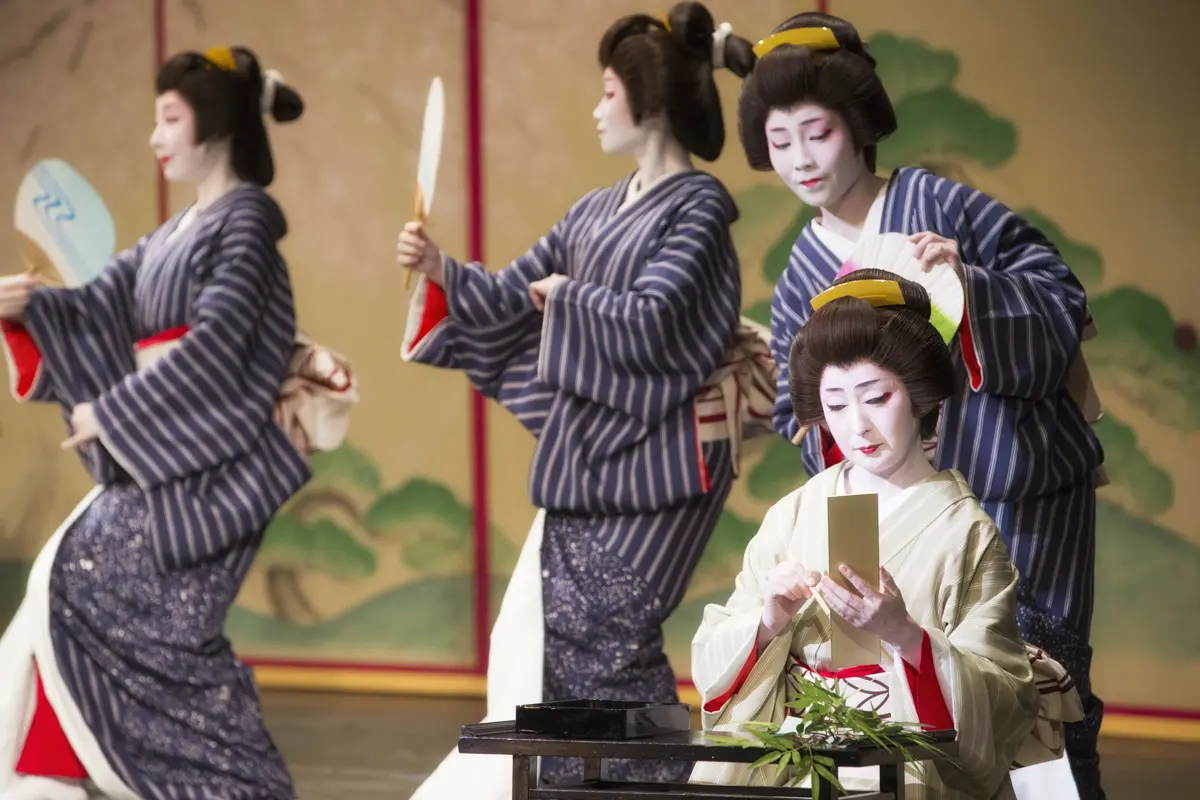
Some choose to becomejimae geiko, independent, managing their own benefits and expenses. Others remain attached to their okiya. The system remains rigorous: to attend aozashiki, banquet with geisha, you often need a recommendation, a substantial budget, and some savoir-vivre.
Cultural transmission and recognition
Over the years, the role of geisha evolves. Less present in daily life, it becomes aheritage symbol1Japanese arts transmission vector, sometimes even a cultural ambassador abroad.

Preservation efforts are made by local associations, often supported by municipalities. Shows open to the public, discovery programs, and framed experiences allow today to approach this culture without distorting it.
The history of geishas is a mirror of Japanese history, its social hierarchies, its grey areas and its reforms. Understanding their journeys, distinctions and transformations makes it possible to better grasp a living facet of Japanese culture, well beyond the frozen clichés.
If this article has brought you useful information and can help other travellers prepare for their stay, a Google review will always be appreciated. |
|
Discover more from Evasions Rebelles - Travel Planner Japon
Subscribe to get the latest posts sent to your email.