
Beyond the famous Yoshiwara neighbourhood, Japan of the Edo era saw the emergence of a multitude of places called “Okabasho”, unofficial areas of pleasure. Less codified but more accessible, they have shaped an entire part of the urban, cultural and social life of Edo. Their existence raises questions about regulation, marginality and daily life in the pre-modern Japanese capital.
Definition and origin of Okabasho
The word “Okabasho” refers to unofficial prostitution establishments that existed in parallel with the Yoshiwara, the only neighborhood legally recognized by the Shogunate for this activity. The “oka” element, meaning “external” or “peripheral”, indicates their status outside the regulated system.
The Okabasho emerged from the beginning of the Edo era, taking advantage of areas outside the strict controls of the administration. They took root in places initially anodized: relay inns, tea houses near temples, bath establishments or outlying areas of major commercial roads.
Operation and peculiarities
Unlike Yoshiwara, which was governed by strict rules, the Okabasho enjoyed greater freedom of organisation. They had neither closed enclosures nor complex hierarchical structures. The cost of services was generally lower, making them accessible to a wider clientele.
The staff included women sometimes from the working class, hired without contractual formality. Some played a role closer to that of waitresses, reinforcing the hybrid and blurred character of these places, halfway between establishment of pleasure and space of sociability.
Symbolic locations and geographical distribution
The Okabasho were distributed throughout Edo. They included:
- in popular areas like Fukagawa, Asakusa or Yanaka
- along the four major postal routes of Edo: Shinagawa, Itabashi, Naitō Shinjuku and Senju
- near certain temples and shrines, taking advantage of the flow of pilgrims and visitors
- in the suburbs, where administrative supervision was more relaxed
These areas experienced marked growth in the 18th century until their peak in the late Tenmei era (late 1780s). They sometimes formed small, lively neighbourhoods, integrated into local economic and social life.
The authorities’ eyes
The Okabasho have always been a problem for the authorities. Perceived as hotbeds of moral disorder and social destabilization, they were subjected to several closure campaigns. The major moral and economic reforms of the period — notably those of Kansei (1787–93) and Tenpō (1841–43) — were aimed at eradicating these settlements.
Dozens of sites were officially banned and dismantled. However, in fact, many settled elsewhere or hidden behind legal facades (tea houses, inns). This resilience reflects the profound role these places played in the urban economy and in social needs not taken into account by the official system.
A space for social ambiguity
The Okabasho were also spaces of passage and transgression. He crossed merchants, artisans, students, low-ranking samurai or peasants on the move. The relaxation of the conventions allowed for a unique social mixing.
It also provided a form of relative freedom for women, albeit in a precarious environment. Some were able to make a name there, others were temporarily passing there before attempting to convert or marry. The boundary between coercion and choice, as often in the history of prostitution, remains complex to trace.
Cultural heritage and representations
The Okabasho have marked the collective Japanese imagination. Many pieces of rakugo (Japanese humorous tale) and kabuki evoke them, sometimes with derision, sometimes with nostalgia. They appear in popular narratives as a backdrop of upset love, scams or comic misadventures.
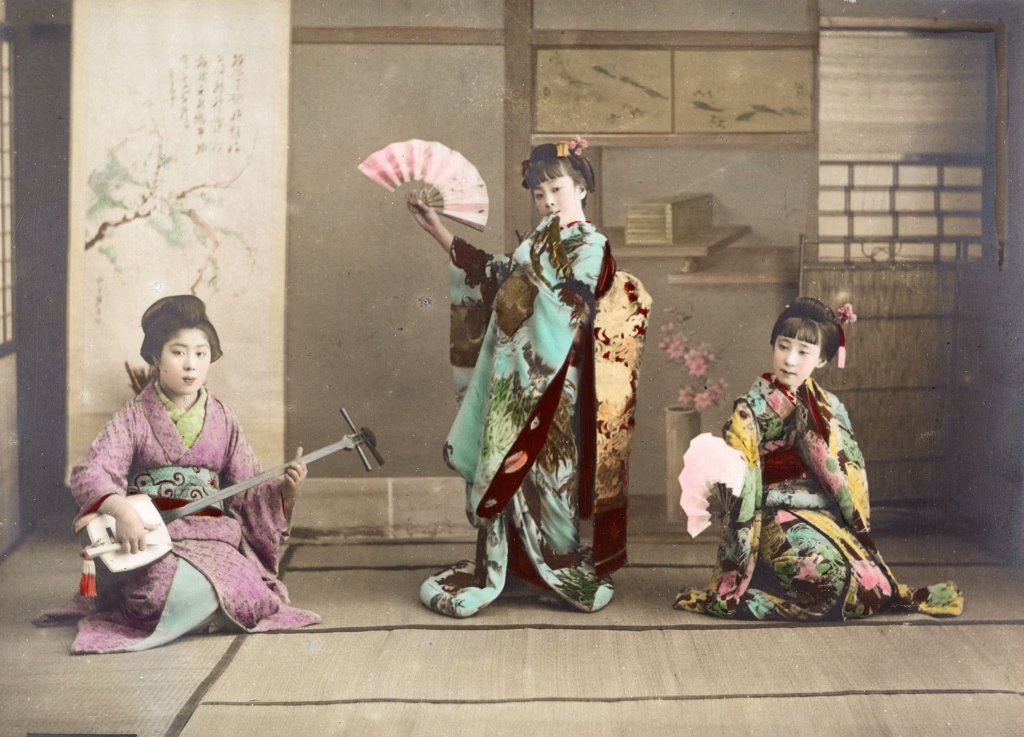
In modern times, historians have restored to these places their importance in the study of Edo society. They are regarded as markers of a living city, with full margins of initiatives, far from the rigidity of a frozen system.
While the Okabasho have left few visible traces in contemporary Tokyo, their memory persists in neighborhood names, judicial archives and literary works. They offer a valuable mirror to understand the social dynamics of a time when the regulation of pleasure, far from being uniform, revealed the tensions between centralized power and urban daily life.

Si cet article vous a apporté des informations utiles et peut aider d’autres voyageurs à préparer leur séjour, un avis Google en cliquant sur l’image suivante sera toujours apprécié.

Pour une dose de Japon au quotidien, suivez-nous sur Threads
Discover more from Evasions Rebelles - Travel Planner Japon
Subscribe to get the latest posts sent to your email.


