In Nagasaki Prefecture, in the far west of Kyushu Island, the port city of Sasebo is home to a fascinating tradition: that of the artisanal toupee called Sasebo-goma. This wooden toy, more complex than it seems, embodies regional know-how transmitted from generation to generation. It is a living heritage still very active today, both playful object, artistic support and cultural emblem.
What is Sasebo’s top?
Sasebo’s toupie is clearly distinguished from other types of Japanese toupies by its shape and materials. It has an ovoid silhouette, somewhere between the onion and the shallot, surmounted by a metallic diamond-shaped tip. This tip plays a crucial role in its stability during rotation.
The wood used for its manufacture comes from the treematebashii, a variety of Japanese oak renowned for its solidity. Thanks to this dense essence, the top is more resistant to repeated ground shocks and friction during combat.
Its appearance is codified: the applied colours evoke the five elements of Chinese cosmology, often used in traditional Japanese aesthetics. The black symbolizes water, red the fire, yellow the earth, green the wood and white the metal. Black and white also refer to the balance between opposites, such as Yin and Yang.
Origins and history of Japanese toupies
The first toupies arrived in Japan from China and the Korean peninsula before the eighth century. They were then the home of the aristocracy and played a ceremonial role. It was only in the 14th century that their use was democratized and the game became popular throughout Japanese society.
During the Edo period (1603-1868), toupee fighting gained popularity to the point of attracting betters. Some forms of gambling were prohibited because of their connection to the then prohibited gambling. It is in this context that new types of toupies are developing, including Sasebo’s.
The fights of toupies then become an art combining precision, strategy and skill. Each region develops its models, often adapted to local manufacturing conditions and regional aesthetic tastes.
Launching a Sasebo toupee: instructions for use
Rotating a Sasebo top requires a little bit of training but follows a very precise method:
- Place the top upside down, metal tip up.
- Roll the string flat around the body of the toupee, starting from the tip to the central marker.
- Hold the end of the string with one hand, throw the top of a sharp movement and pull the string immediately.
This movement results in a rapid reversal of the toupee, which then stabilizes on its metal tip. A good pitch allows a long rotation, an essential condition for winning a fight.
Sasebo-goma and other traditional toupies
Although the Sasebo toupie is the best known in the Nagasaki region, it is part of a wider tradition of toupies in Japan, calledkoma. These toys exist in different forms: flat, spherical, triangular or even with divinatory or musical functions.
Old variants include:
- Beigoma: miniature metal toupee thrown on a canvas stretched over a bucket. It emits a characteristic buzz. The practice ofBeigomaoften includes manual modifications of the toy to optimize rotation or shock power.
- Daruma-gomainspired by the figure of the monk Daruma, this toupee is used in games of chance.
- Sakadachi-goma: designed to turn backwards.
- Zuguri-goma: specific to some local parties and known for its rich decoration.
- Jindai-goma: Historically marked by the Shimazu clan coat of arms in the Miyazaki region.
These objects, often associated with seasonal events or address games, illustrate the cultural diversity associated with the tops in Japan.
The annual Sasebo tournament
Every 2 January, the city of Sasebo organizes theShinshun Koma Mawashi TaikaiA toupies tournament that marks the beginning of the year. About 150 participants compete in a friendly atmosphere, combining technical performance and festive spirit.
This event attracts enthusiasts from all over the region and beyond. The duels test the precision of the cast, the quality of the production of the toupee and the endurance of the rotation. This tournament contributes to the vitality of tradition and stimulates the interest of the youngest.
Sasebo-Koma-Honpo: the inescapable workshop
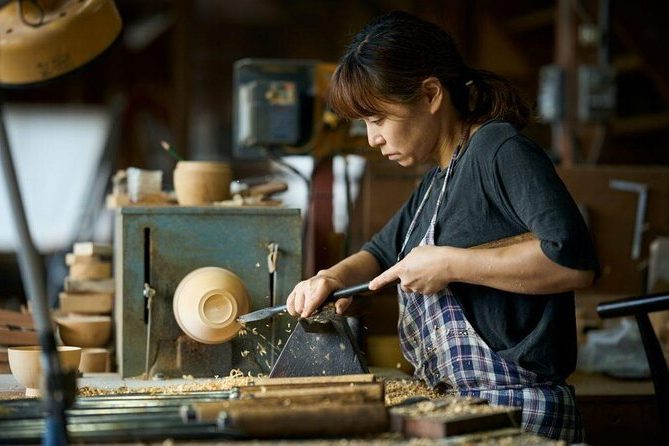
Sasebo-Koma-Honpo is the only workshop officially dedicated to the manufacture of Sasebo toupies. Here is where the art of wooden toupee, from sculpture to manual painting continues. Each piece is unique, made according to traditional methods.
The site also proposesparticipatory workshops: by reservation, visitors can paint their own toupee and attend manufacturing demonstrations. These moments of exchange make it possible to understand the stages of creation: choice of wood, cutting, balancing, decoration.
The experience is often extended by demonstrations of combat between artisans and visitors. This playful initiation allows you to better appreciate the address needed to launch a trick.
The toupies are available for purchase, with prices ranging from 800 to 50,000 yen, depending on the models and the finish. The most expensive pieces are intended for exhibition or collection.
A Living Legacy
Unlike other old toys that have fallen into disuse, Sasebo’s toupie continues to be used, offered and transmitted. It is sometimes compared to the modern Beyblade phenomenon, which is partly inspired by it. But where the industrial version focuses on technology and marketing, the Sasebo-Goma values the artisan’s hand and regional heritage.
This toy thus embodies a form of sustainable cultural transmission. It lends itself as much to the awakening of children as to the aesthetic contemplation of adults, bringing together several generations around the same simple gesture: to make a spin.
Visiting Sasebo and discovering this unique craft, one comes into contact with an unknown facet of Japan, which combines know-how, fun of the game and local memory. The rustling of a spinning toupee then becomes much more than just a noise: it is echo of a still alive tradition.
If this article has brought you useful information and can help other travellers prepare for their stay, a Google review will always be appreciated. |
|
Discover more from Evasions Rebelles - Travel Planner Japon
Subscribe to get the latest posts sent to your email.