The pilgrimage of the 88 temples of Shikoku (Shikoku Henro) is a sacred loop of about 1,200 km that crosses the four prefectures of the island: Tokushima, Kōchi, Ehime and Kagawa. It connects 88 “official” temples where Buddhist monk Kūkai (Kōbō Daishi) trained in IXecentury. This hub guide gathers everything you need to know before you leave: the classic circuit, variants, the pilgrim’s outfit, accommodations, budgets and answers to the most frequent questions.

PDF Guide to Shikoku Pilgrimage
Before you go, download our PDF guide: we compiled the tips, opinions and practical recommendations to start the Shikoku Henro (steps, accommodation, budget, variants). The PDF will only be displayed on request so that it does not weigh up the page — click the button below to open or download it.
Interactive map of the pilgrimage
The loop of the 88 temples covers the four prefectures of Shikoku. To view the steps and prepare your itinerary, display the interactive map below — it is only loaded by click, without third-party cookie when loading the page.

Pilgrimage
Shikoku Henro is a 1,200 km circular pilgrimage that crosses the island’s four prefectures. Here is his story, his motivations and how to approach him.
The first reference to the Shikoku pilgrimage appears in documents dating from the XIIecentury, but there is no mention of temples or specific routes. It is believed that the present pilgrimage composed of the 88 temples was formed between the end of the XVIeand XVIIecentury. In the modern era, with the development of roads, more and more people come to make the pilgrimage by car or bus, but it is not uncommon to see pilgrims still on foot.
The motivations of people to make this pilgrimage are varied. Some come for religious reasons, others to pray for healing or safety at home, or for the memory of those who died. Still others come simply to get away from ordinary life, for leisure, or to spend time alone thinking and meeting.
This pilgrimage is a mythical journey (think about completing your goshuin) on a spiritual journey. This circuit passes through many beautiful cities of Shikoku, including Naruto, Awa, Tokushima,KōchiOr even Matsuyama.
Transition: Once the context has been set, let us look at the traditional starting point of the pilgrimage.
The First Temple
Temple No. 1, Ryōzen-ji, marks the departure of the pilgrimage to Tokushima Prefecture. There are three ways to navigate the loop: jun-uchi, gyaku-uchi and kugiri-uchi.
Many people begin at Temple 1, Ryōzen-ji in Tokushima Prefecture, proceed clockwise and end up at Temple 88, This method is calledJun-uchiand it is easier to follow the path markers in this way. Others go in reverse order, calledgyaku-uchi, but there is no rule as to the order in which you visit the temples.
Another method is calledKugiri-uchi, which means completing part of the pilgrimage in one time. This is quite common because most people cannot easily leave their daily lives for a few weeks or more. Thus, some visit the temples of a prefecture or some complete miniature pilgrimages, i.e. between temples 13 and 17, or temples 71-77. It is important to start and proceed at your own pace and in your own way.
Transition: Now that the starting point is clear, let’s go through the complete loop of the 88 temples.
The classic circuit
The classic circuit (jun-uchi) follows the order of the 88 temples, from Ryōzen-ji to 的kubo-ji. Here is the map of the route and the complete list of temples with their location.

You can findHerethe list of the 88 temples that make up this pilgrimage.
| 1 | Ryōzen-ji | Naruto | Tokushima |
| 2 | Gokuraku-ji | Naruto | Tokushima |
| 3 | Konsen-ji | Itano | Tokushima |
| 4 | Dainichi-ji | Itano | Tokushima |
| 5 | Jizō-ji | Itano | Tokushima |
| 6 | Anraku-ji | Kamiita | Tokushima |
| 7 | Jūraku-ji | Awa | Tokushima |
| 8 | Kumadani-ji ( | Awa | Tokushima |
| 9 | Hōrin-ji | Awa | Tokushima |
| 10 | Kirihada-ji ( | Awa | Tokushima |
| 11 | Fujii-dera | Yoshinogawa | Tokushima |
| 12 | Shōsan-ji | Kamiyama | Tokushima |
| 13 | Dainichi-ji | Tokushima | Tokushima |
| 14 | Jōraku-ji | Tokushima | Tokushima |
| 15 | Kokubun-ji | Tokushima | Tokushima |
| 16 | Kan’on-ji | Tokushima | Tokushima |
| 17 | Ido-ji | Tokushima | Tokushima |
| 18 | Onzan-ji | Komatsushima | Tokushima |
| 19 | Tatsue-ji | Komatsushima | Tokushima |
| 20 | Kakurin-ji | Katsuura | Tokushima |
| 21 | Tairyū-ji | Anan | Tokushima |
| 22 | Byōdō-ji | Anan | Tokushima |
| 23 | Yakuō-ji | Minami | Tokushima |
| 24 | Hotsumisaki-ji | Muroto | Kōchi |
| 25 | Shinshō-ji | Muroto | Kōchi |
| 26 | Kongōchō-ji | Muroto | Kōchi |
| 27 | Kōnomine-ji | Yasuda | Kōchi |
| 28 | Dainichi-ji | Konan | Kōchi |
| 29 | Tosa Kokubun-ji | Nankoku | Kōchi |
| 30 | Zenraku-ji | Kōchi | Kōchi |
| 31 | Chikurin-ji | Kōchi | Kōchi |
| 32 | Zenjibu-ji | Nankoku | Kōchi |
| 33 | Sekkei-ji | Kōchi | Kōchi |
| 34 | Tanema-ji | Haruno | Kōchi |
| 35 | Kiyotaki-ji | Tosa | Kōchi |
| 36 | Shōryū-ji | Tosa | Kōchi |
| 37 | Iwamoto-ji | Shimanto | Kōchi |
| 38 | Kongōfuku-ji | Tosashimizu | Kōchi |
| 39 | Enkō-ji | Sukumo | Kōchi |
| 40 | Kanjizai-ji | Ainan | Equine |
| 41 | Ryūkō-ji | Uwajima | Equine |
| 42 | Butsumoku-ji | Uwajima | Equine |
| 43 | Meiseki-ji | Seiyo | Equine |
| 44 | Daihō-ji | Kumakōgen | Equine |
| 45 | Iwaya-ji | Kumakōgen | Equine |
| 46 | Jōruri-ji | Matsuyama | Equine |
| 47 | Yasaka-ji | Matsuyama | Equine |
| 48 | Sairin-ji | Matsuyama | Equine |
| 49 | Jōdo-ji | Matsuyama | Equine |
| 50 | Hanta-ji | Matsuyama | Equine |
| 51 | Ishite-ji | Matsuyama | Equine |
| 52 | Taisan-ji (Matsuyama) | Matsuyama | Equine |
| 53 | Enmyō-ji | Matsuyama | Equine |
| 54 | Enmei-ji | Imabari | Equine |
| 55 | Nankōbō ( | Imabari | Equine |
| 56 | Taisan-ji | Imabari | Equine |
| 57 | Eifuku-ji | Imabari | Equine |
| 58 | Sennyū-ji | Imabari | Equine |
| 59 | Kokubun-ji | Imabari | Equine |
| 60 | Yokomine-ji | Saijō | Equine |
| 61 | Kōon-ji | Saijō | Equine |
| 62 | Hōju-ji | Saijō | Equine |
| 63 | Kichijō-ji ( | Saijō | Equine |
| 64 | Maegami-ji | Saijō | Equine |
| 65 | Sankaku-ji | Shikokuchūō | Equine |
| 66 | Unpen-ji | Miyoshi | Tokushima |
| 67 | Daikō-ji | Mitoyo | Kagawa |
| 68 | Jinne-in | Kan’onji | Kagawa |
| 69 | Kannon-ji | Kan’onji | Kagawa |
| 70 | Motoyama-ji (本 | Mitoyo | Kagawa |
| 71 | Iyadani-ji | Mitoyo | Kagawa |
| 72 | Mandara-ji | Zentsūji | Kagawa |
| 73 | Shusshaka-ji | Zentsūji | Kagawa |
| 74 | Kōyama-ji | Zentsūji | Kagawa |
| 75 | Zentsū-ji | Zentsūji | Kagawa |
| 76 | Konzō-ji | Zentsūji | Kagawa |
| 77 | Dōryū-ji | Tadotsu | Kagawa |
| 78 | Gōshō-ji | Utazu | Kagawa |
| 79 | Tennō-ji | Sakaide | Kagawa |
| 80 | Sanuki Kokubun-ji | Takamatsu | Kagawa |
| 81 | Shiromine-ji | Sakaide | Kagawa |
| 82 | Negoro-ji | Takamatsu | Kagawa |
| 83 | Ichinomiya-ji | Takamatsu | Kagawa |
| 84 | Yashima-ji | Takamatsu | Kagawa |
| 85 | Yakuri-ji | Takamatsu | Kagawa |
| 86 | Shido-ji | Sanuki | Kagawa |
| 87 | Nagao-ji | Sanuki | Kagawa |
| 88 | Sanuki | Kagawa |
Transition: the circuit is traced. Let us now see the traditional equipment of the pilgrim.
The Pilgrim’s Dress
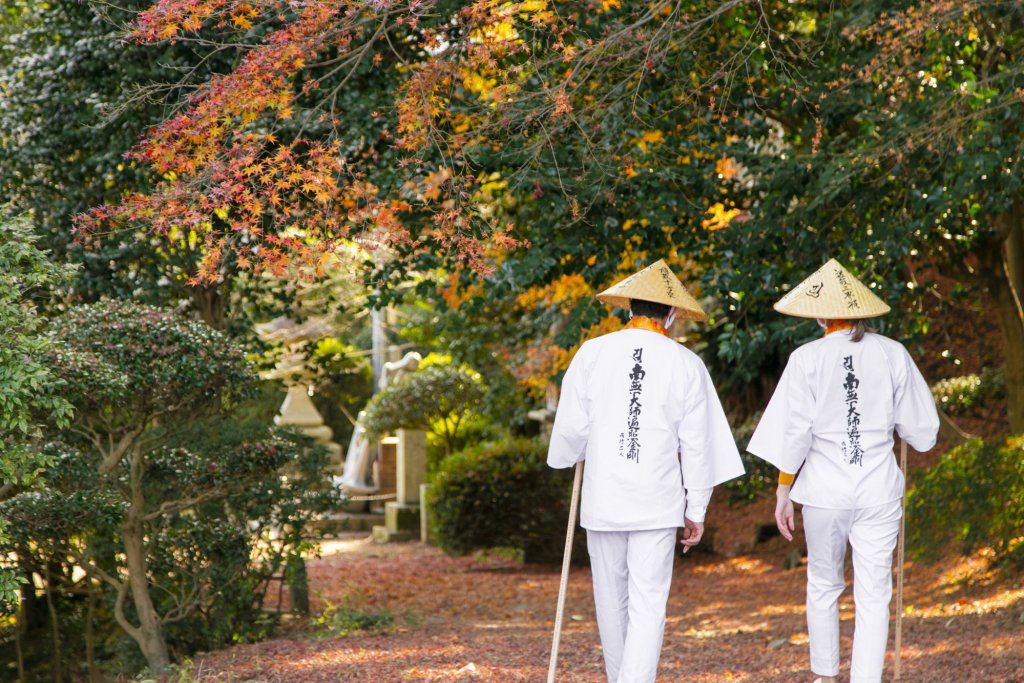
The traditional dress of the Henro (pilgrim) includes several symbolic elements, worn even in temples. Here is the complete list with their meaning.

Sugegasa– Conical hat: protects from the sun and rain, carried even in temples.
Hakui– White clothing: symbol of purity, also evokes the preparation to die.
– Juzu– Hat: soothes the mind, attracts luck in prayers.
Jirei– Bell : agitated after each sutra to rhythm the recitations.
Zudabukuro– Besace: contains incense, candles, notes, notebooks and ritual objects.
• Wagesa– Monk’s dress: shows faith, free color according to preferences.
– Kongōzue– Stick: represents Kōbō Daishi, spiritual support of the pilgrim.
Osamefuda– Offer ticket: personal greetings, deposited in the visited temples.
Nōkyōchō– Pilgrim’s notebook: is used to collect buffers and calligraphy of temples.
The traditional pilgrim’s costume includes a white shirt indicating that it is a pilgrim, a conical sedge hat, a shoulder bag and a walking stick. The white garments worn by the pilgrim represent purity and innocence, and in the past they also had the meaning of a shroud of death, symbolizing the fact that the pilgrim was ready to die at any time. The henro shoulder bag contains prayer beads, incense sticks, coins used as offerings in temples, a small bell, as well as sutra books, which are sung in temples along the pilgrimage path. Upon arrival at each temple, henro washes his hands at a stone fountain before going to the temple’s main building. After offering coins and incense, the Heart Sutra is sung, then pilgrims can ring the temple bell and visit other parts of the temple. Local populations frequently offer food and shelter to pilgrims, and such gestures are seen as a way to thank Kūkai. Most temples offer accommodation for pilgrims and there are also hotels and traditional accommodations along the pilgrimage route.
This pilgrimage, often called “Shikoku 88”, is listed as an important Japanese heritage site and constitutes a unique cultural treasure that represents significantly the soul of the nation and its inhabitants. The island of Shikoku is a must-see with beautiful sea and mountain views, an incredible range of culinary delights and unique, ancient and unknown places.
Shikoku Pilgrimage FAQ
The most frequent questions of travellers preparing the Shikoku Henro, with concrete figures.
How many days does it take to make the pilgrimage of the 88 temples of Shikoku?
Count 40 to 60 days on foot for the full 1,200 km (8 to 10 weeks) loop, 20 to 30 km per day. By car, the circuit takes 8 to 10 days; by bus, in 10 to 12 days. Most travellers opt forKugiri-uchi: 5 to 7 days for a prefecture (about 20 temples). If you have 2 weeks, focus on Tokushima (temples 1-23) and Kōchi (24-39), the two prefectures most accessible by public transport.
What is the best time to walk on the Shikoku Henro?
Spring (March to May) and autumn (October to November) are ideal times: temperatures from 15 to 22 °C, low rainfall, flowery landscapes in spring. Summer (June to September) is very wet (30 to 35 °C, 80% humidity) and corresponds to the typhoon season; Avoid July and August if you walk. Winter (December to February) remains practical on the coastal plains (5-12°C), but the temple passes 12, 20, 60 and 66 can be snowed. There are 6,000 to 9,000 yen in a temple dormitory (shukubō) and 8,000 to 14,000 yen in a business hotel in high season.
How much does the Shikoku pilgrimage cost?
On foot, there are 8 000 to 12 000 yen per day (50 to 75 €) in the backpacker budget: 3,000 to 5,000 yen of shukubō ( temple sleeper with dinner and breakfast), 2,000 to 3,000 yen of meals, 500 to 1,000 yen of offerings (osamefuda, incense, goshuin at 300 yen each). In comfort (business hotel + restaurants), plan 15,000 to 22,000 yen per day (95 to 140 €). For the complete loop on foot (50 days), the total budget ranges from 400,000 to 600,000 yen (2,500 to 3,800 €), excluding transport to Shikoku. A full-service rental package (hakui, sugegasa, kongōzue, juzu) costs 8,000 to 15,000 yen in Takamatsu or Tokushima.
How to travel on the Shikoku pilgrimage without a car?
The train and bus cover about 70% of temples. TheJR Shikoku Pass(2 days: 6,000 yen, 3 days: 8,000 yen, 5 days: 10,000 yen) allows free movement on the island’s JR lines. For isolated temples (12, 20, 27, 38, 45, 60, 66), local buses serve the nearest train stations (300 to 800 yen per journey), but take an additional 30 to 60 min walk. The most flexible solution remains the rental car (5,500 to 7,500 yen/day + 1,500 yen insurance) or the shared taxi for mountain sections. Electric bicycles are available in Tokushima and Matsuyama (2,000 to 3,000 yen/day).
What must be taken for the Shikoku Henro?
Traditional dress is not mandatory, but it is appreciated by temples and premises. The essentials: a backpack of 30 to 40 L (max 8 kg), walking shoes that have already been worn, an impermeable windbreaker (the showers are frequent, 1,500 to 3,000 yen for a poncho), a gourd of 1 L (free of charge in temples), sunscreen, a nōkyōchō notebook (1,500 to 2,500 yen) for buffers, and 5,000 to 10,000 yen in liquid (all temples do not accept the map). If you buy the complete outfit on site: hakui 2,500 yen, sugegasa 2,000 yen, kongōzue 1,500 yen, juzu 1,500 yen, or about 8,000 yen in Takamatsu or Tokushima.
Shikoku Henro is not just a hike: it is an internal journey that crosses four prefectures, 88 temples and a thousand years of Buddhist history. Whether you walk 50 days or 5 days, the essential thing is to start. And if you prefer to prepare your itinerary with a local, we are here to help you build a course at your own pace.
|
If this article has brought you useful information and can help other travellers prepare for their stay, a Google review will always be appreciated. |
|
Discover more from Evasions Rebelles - Travel Planner Japon
Subscribe to get the latest posts sent to your email.