Silent silhouettes with a large straw hat, bamboo flute in hand, komusō immediately intrigue travellers who cross their image in Japanese temples, museums or historical dramas. Behind this recognizable figure lies a complex story mixing Zen Buddhism, traveling spiritual practices, political control and popular imagination. Understanding the komusō makes it possible to enrich the discovery of Japan, beyond the clichés, and to approach certain places and traditions with a more enlightened look.

Who were the komusō
The komusō were monks affiliated with Fuke School, a particular branch of Zen Buddhism. Their name literally means “monks of nothing”, a central notion in their spiritual approach. Unlike other Buddhist monks, they did not shave their heads and occupied an ambiguous position, halfway between monastic life and secular condition. This singularity partly explains the fascination they still exercise today.
The origin of the movement dates back to the introduction in Japan of teachings from China, transmitted by Zen monks who emphasized an original spiritual practice based on music. For the komusō, the breath and sound were a way of awakening as did the sitting meditation.
The practice of shakuhachi as a spiritual path
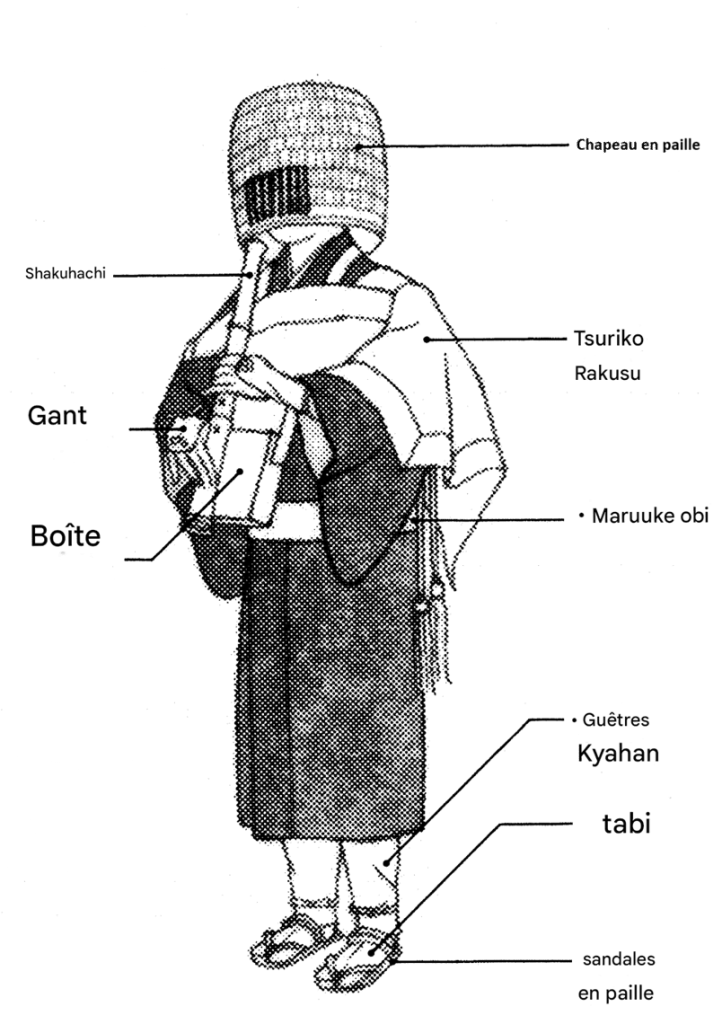
The most emblematic element of komusō is the shakuhachi, a bamboo flute with deep and meditative sound. Playing this instrument was not entertainment but a practice called suizen, meditation by breath. Each note, each silence, participated in an inner search for a form of detachment and lucidity.
This approach distinguishes the komusō from other Zen schools that favour zazen, seated meditation. For the curious traveller, attending a shakuhachi demonstration in a temple or cultural centre makes it possible to feel the intensity of this practice, often more spoken than a simple theoretical explanation.
Straw hat and anonymity symbolism
The large straw hat, called tengai, covered the entire face of the komusō. This choice was not aesthetic but symbolic. It reflected the rejection of the ego and the individual identity. By concealing their traits, the monks claimed that only practice counts, not the person who executed it.
The hat also had a social and political function. It allowed movement without being recognized, which played a particular role during certain periods of Japanese history. For travellers, understanding this symbol avoids reducing the komusō to a simple exotic or folk figure.
Komusō and traveling life
The komusō were walking around the country, from village to village, living alms. This homelessness was an integral part of their asceticism. The journey, the uncertainty and the meeting of the other were considered as training tests. This dimension resonates with the importance of displacement in Japanese culture, where the path is as important as the destination.
When soliciting alms, certain codified formulas were used by the inhabitants to reject politely. These ritualised exchanges bear witness to a precise social framework, which is now gone, but whose traces are found in popular expressions and narratives.
Supervision and distrust during the Edo era
From the Edo era, the authorities began to strictly supervise the komusō. Their freedom of movement gave rise to suspicions, all the more so as some individuals pretended to be monks in order to escape justice or travel without constraints. This situation led to a multiplication of false komusō, helping to blur the image of the movement.
Precise regulations were then established regarding their behaviour, behaviour and movement. Clothing, sandals, wearing shakuhachi and even authorized objects were precisely defined. This normalization was intended to distinguish true practitioners from impostors.
Official disappearance and modern renaissance
With the restoration of Meiji, Fuke School was officially dissolved. The komusō lost their religious status and were registered as ordinary citizens. This rupture marked the institutional end of the movement, but not its legacy.
At the end of the 19th century, initiatives enabled the practice of shakuhachi to be revived in a spiritual and artistic setting. Some temples, especially in Kyoto, became teaching centres where traditional komusō-related pieces were transmitted. Today, these places are interesting steps for travellers passionate about Japanese music and spirituality.
Komusō in popular imagination and historical dramas
The figure of komusō occupies a prominent place in Japanese cinema and historical series. The hat concealing the face has often been used to represent spies, assassins or samurai seeking to mask their identity. This spectacular performance has greatly contributed to the reputation of komusō outside Japan.
It is useful to bear in mind that these uses are more fictional than historical reality. Travelers who love sword movies will benefit from distinguishing the dramatic image from authentic religious practice.
Where to discover the komusō heritage today
Several temples and museums in Japan evoke the history of the komusō and present ancient shakuhachi, clothes or documents related to the Fuke school. Some venues offer concerts or initiations to approach this tradition in a respectful way.
In Kyoto, the former spiritual capital, several temples linked to Zen retain a living memory of this practice. To plan a relevant visit, it is recommended to learn about schedules, behavioral rules and specific events, in order to avoid disappointment.
Practical tips for curious travellers
When a trip includes the discovery of Japanese spiritual traditions, some principles facilitate experience. Observing silence during musical demonstrations, avoiding unauthorized photographs and adopting a discreet outfit testify to appreciated respect. Understanding the meaning of practices also allows us to ask more relevant questions in discussions with the managers of the premises.
Integrate this type of visit into a balanced itinerary, alternating famous sites and more confidential discoveries, offers a more nuanced vision of Japan. The komusō, although not visible today, is an original gateway to the country’s religious and cultural history.
The komusō embody a unique facet of Japan, where music, travel and inner quest come together. Taking the time to understand their history and symbolism, the traveller enriches his gaze and approaches temples and traditions with a new depth, far from the reductive images.
Discover more from Evasions Rebelles - Travel Planner Japon
Subscribe to get the latest posts sent to your email.