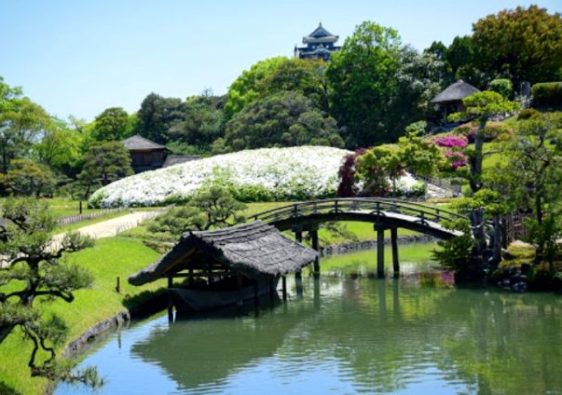
Discreet, almost invisible, suikinkutsu is a sound element of Japanese gardens that combines aesthetics, serenity and acoustic subtlety. This rare object, often unknown to visitors, deserves attention to understand the art of silence in Japan and how sounds can enrich the experience of a garden.

Origin and principle of suikinkutsu
Thesuikinkutsu“Koto d’eau” is a refined invention of the Edo era. Its principle is based on a simple but ingenious technique: a ceramic jar is buried upside down in the ground, with an opening at the top. When water drops fall through this small orifice to reach a thin thread of water stagnant at the bottom, they produce a crystalline sound similar to that of a koto, a traditional Japanese string instrument.
This almost musical sound reverberates in the jar and reaches the ear in a diffuse way. The device, although invisible, becomes a point of sound attention in the garden environment, strengthening the feeling of calm and introspection.
Position in the garden and ritual use
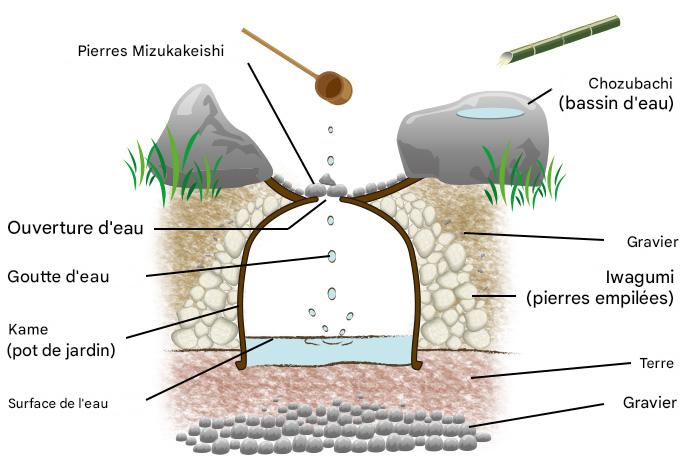
It is often placed next to achōzubachi, a stone basin intended for ritual ablutions before the tea ceremony. It is the water used to purify itself which then flows to suikinkutsu, without mechanical intervention. The sound is therefore only triggered in response to a human gesture, emphasizing the relationship between man, gesture and the natural environment.
This type of device is part of the aesthetics ofwabi-sabi, which values simplicity, fugacity and imperfection. The suikinkutsu, hidden under the ground, does not show but listen. It thus reinforces the sensory dimension of the Japanese garden, where each element – stones, vegetation, water, sounds – contributes to a global balance.
In some configurations, a simple carved stone or bamboo tube is placed above the jar to allow the visitor to approach the ear and listen to the drops resonate.
Manufacture and installation
It requires a real artisanal mastery. The jar must beterracotta, often partially varnished inside to promote resonance. It is buried at a specific depth, often in a gravel bed allowing water to move without stagnating. The top hole must be adjusted accurately to control the drop flow.
The sound environment is also studied: it must becalm, without any harmful noises, so that the drops are perceptible. Temple gardens, tea pavilions and some traditional ryokans are sometimes equipped, but the installation remains rare outside the places designed according to the rules of the Zen garden.
Some contemporary artisans perpetuate manufacturing, sometimes adapting materials or shapes to modern environments, while respecting the fundamental principles of the device.
Where to listen to a suikinkutsu in Japan
It is found in several temples, traditional gardens or tea pavilions across Japan. Some of the best known are located inKyotoor inOld Kanazawa Gardens. Others, more discreet, hide in less touristic places, such as private gardens or Japanese art museums.
It is rare to cross by chance. Most of the time, their presence is indicated by a small indication, or suggested by a guide or host who invites you to listen. Listening then becomes an intimate and attentive moment, a pause out of tumult, often unforgettable for the visitor who discovers it for the first time.
It is recommended to avoid noisy periods or high influence to fully appreciate the subtle sound of drops. Some places even allow guided listening with an acoustic tube-like instrument to better capture resonances.
The suikinkutsu embodies a often overlooked sound dimension of the Japanese garden. Invisible but present, it offers a moment suspended to those who take the time to listen. More than just a decorative object, it invites us to contemplate and rediscover the silence punctuated by the beauty of a simple drop of water.
If this article has brought you useful information and can help other travellers prepare for their stay, a Google review will always be appreciated. |
|
Discover more from Evasions Rebelles - Travel Planner Japon
Subscribe to get the latest posts sent to your email.