Shibuya Station, in the heart of Tokyo, is one of the busiest and most complex stations in the city. It serves many private and JR lines, as well as the metro, and has several main exits allowing access to commercial, cultural and tourist areas. Finding in this station is essential to fully enjoy Shibuya and its surroundings, avoid waste of time and succeed in connecting lines. Here is a practical guide to exits, transfers and points of interest nearby.
The main outputs of Shibuya Station
Shibuya Station has four main JR windows, each providing access to specific outputs. TheHachiko Gateleads to the famous Hashikō statue and the most iconic pedestrian junction, the Scramble Crossing, as well as Miyashita Park and the Center-Gai district. It is the most frequented and lively exit, especially in the evening.
TheCentral Gate, located on the third floor, provides access to Shibuya Scramble Square, SHIBUYA SKY Observatory (2,500 yen entrance), Shibuya Hikarie and Shibuya Stream. This counter is the most convenient for connections with the metro and private lines, thanks to its internal passages.
TheSouth Gateserves the bus terminal, taxis, Tokyu Plaza and exits East and West. It is ideal for congested or pressed travellers, with direct access to surface public transport.
Finally, theNew South Gateis close to Narita Express, Saikyo, Shonan-Shinjuku and Rinkai, as well as the Mets Shibuya hotel, offering a quieter and less frequented access, appreciated by travellers with luggage.
Transfers between lines and navigation in the station
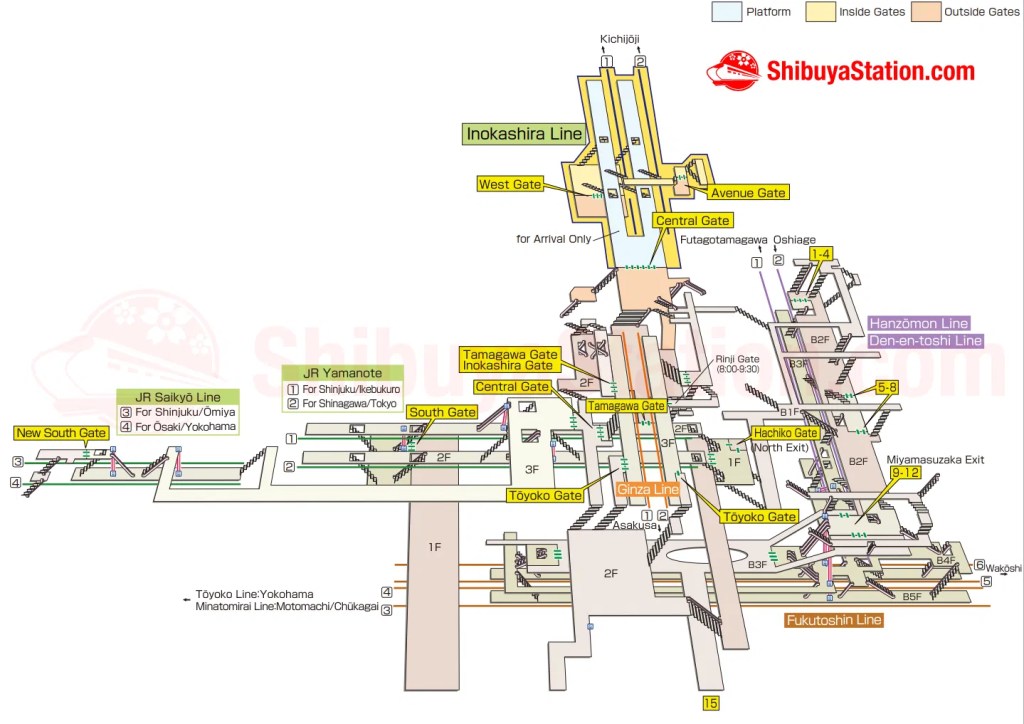
Shibuya Station is served by five main JR lines and six other private or metro lines. Transfers usually require exit from a JR counter to enter the corresponding line, with connections that can take 5 to 10 minutes depending on the docks.
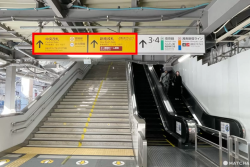
To reach the Tokyo Metro Ginza Line or the Keio Inokashira Line, the Central Gate is the most convenient. The Hachiko Gate provides access to the Tokyo Metro Hanzomon Line and the Tokyu Den-en-toshi Line. The South Gate leads to the Tokyo Metro Fukutoshin Line and the Tokyu Toyoko Line. Orientation signs, available in English, and station staff are essential to avoid detours, especially at peak times when crowds can slow progress.
Access to each exit from the Yamanote platform
From the platforms of the JR Yamanote Line, located on the second floor, the Hachiko Exit is located at the end of the Harajuku dock. Just go down the stairs to reach the Hachiko Gate, in 2 to 3 minutes. The central exit is accessible via the middle stairs of the dock, leading to the Central Gate, with a similar route.
For the South Gate, you have to go down the other stairs leading to the first floor, in 3 to 4 minutes. The New South Gate asks to head to Platforms 3 and 4, then take the escalator to the exit in 4 to 5 minutes. These indications apply to travellers from the Yamanote, the most used line to discover Shibuya.
Trade areas and points of interest around exits
The area around the Hachiko Exit is lively with attractions like SHIBUYA 109, restaurants and bars, as well as the famous pedestrian hub. The area around the Central Gate includes Shibuya Scramble Square, Shibuya Hikarie and Shibuya Stream, with practical interior passages even in the rain, and the SHIBUYA SKY Observatory that offers 360 degree views of Tokyo.
The South Gate offers access to Tokyu Plaza and cafes like Tokyo Kenkyo, with a more comfortable atmosphere. The New South Gate is quieter and suitable for visitors looking for a less crowded environment, with hotels and restaurants nearby. Count 5 to 15 minutes on foot between the different areas, depending on the crowd and the connections.
Restaurants and hotels near Shibuya Station
Visitors can enjoy many dining options within walking distance.Ushihachioffers high-end Kurope Wagyu with views of the crossroads, with menus between 5,000 and 10,000 yen.Ichiran Shibuyaserves an authentic and customizable tonkotsu ramen for 1,000 to 1,500 yen.Mo Mo Paradiseoffers shabu-shabu and sukiyaki in a rich broth, with formulas between 2,500 and 4,000 yen per person.
Mawashi Sushi Katsu Midorihas a wide variety of treadmill sushi, with plates between 150 and 600 yen.Shibuya Yokocho, in Miyashita Park, groups several small signs with various dishes, between 800 and 2,000 yen. For accommodation, theCerulean Tower Tokyu Hotel(25 000 to 50 000 yen at night),Shibuya Excel Hotel Tokyu(20,000 to 40,000 yen) andThe Millennials Shibuya(5,000 to 10,000 yen) offer comfort and proximity to the main exits of the station.
Tips for easy identification
To avoid losing yourself, spot the JR counter for your destination on arrival, then follow the coloured signs that indicate exits and connections. The signs are available in English and Japanese, and the station staff can help you in case of doubt. At rush hours (7:30 a.m.-9:30 a.m. and 5:30 p.m.-19:30 p.m.), the crowd can slow down progress, so allow an additional 10 to 15 minutes for your connections.
Navigation apps like Google Maps or Japan Travel by Navitime work well in the station, but network coverage can be unstable in the basements. Download an offline map before your visit, and note the name of your exit on paper. Finally, avoid getting off the wrong side of the train station: the difference between the Hachiko Exit and the New South Gate can be an additional 10 minutes’ walk.
Locating at Shibuya Station requires some preparation, but once the windows and exits are identified, the station becomes a convenient starting point for exploring Tokyo. This enables visitors to optimize their travel, enjoy nearby attractions and easily access the various railway and metro lines. With a little anticipation and good landmarks, Shibuya Station turns into an ally rather than an obstacle.
How many trips does Shibuya Station count and how to get there?
Shibuya Station has four main JR windows: Hachiko Gate, Central Gate, South Gate and New South Gate. The Hachiko Gate leads to the Hashikō statue and the Scramble Crossing, the Central Gate in Shibuya Scramble Square and SHIBUYA SKY, the South Gate at the bus terminal and Tokyu Plaza, and the New South Gate at the Narita Express and Saikyo lines. Each window gives access to specific exits, with connections to the metro and private lines. Count 5 to 10 minutes between the counters, and 10 to 15 minutes at peak hours.
How to join the Hashikō statue from the Yamanote platform?
From the JR Yamanote Line platforms on the second floor, head towards the end of the Harajuku dock. Go down the stairs to reach the Hachiko Gate, then follow the signs indicating the Hashikō statue. The trip takes 2 to 3 minutes. The statue is right in front of the exit, on the small square facing the Scramble Crossing. In rush hours, the crowd can slow down the progression, so expect a few more minutes.
Which lines are accessible from Central Gate?
The Central Gate, located on the third floor, provides access to the Tokyo Metro Ginza Line and the Keio Inokashira Line, as well as Shibuya Scramble Square, SHIBUYA SKY, Shibuya Hikarie and Shibuya Stream. It is the most convenient counter for connections with the metro and private lines, thanks to its internal passages. Count 5 to 10 minutes between the counter and the docks of the corresponding lines, depending on the crowd and the lifts available.
Where to eat near Shibuya Station?
Several options are available to visitors: Ushihachi for high-end Kurope Wagyu with views of the crossroads (5,000 to 10,000 yen), Ichiran Shibuya for an authentic tonkotsu ramen (1,000 to 1,500 yen), Mo Mo Paradise for Shabu-shabu and Sukiyaki (2,500 to 4,000 yen), Mawashi Sushi Katsu Midori for treadmill sushi (150 to 600 yen on plate), and Shibuya Yokocho for various dishes (800 to 2,000 yen) in Miyashita Park. There are 5 to 10 minutes on foot from the train station exits.
Which hotels are near Shibuya Station?
Three main hotels are nearby: the Cerulean Tower Tokyu Hotel (25 000 to 50,000 yen per night), Shibuya Excel Hotel Tokyu (20 000 to 40,000 yen) and The Millennials Shibuya (5,000 to 10,000 yen per capsule). The New South Gate serves the Hotel Mets Shibuya, quieter and suitable for travellers with luggage. The three establishments are 5 to 10 minutes walk from the main exits, with easy access to the JR and metro lines.
How to avoid getting lost in Shibuya Station during rush hours?
At rush hours (7.30 a.m.-9.30 a.m. and 5.30 p.m.-7.30 p.m.), the crowd can slow down progress. Check out the JR counter for your destination on arrival, follow the coloured signs in English and Japanese, and schedule an additional 10 to 15 minutes for your connections. Download an offline map before your visit, as network coverage can be unstable in basements. Note the name of your exit on a paper and avoid getting out on the wrong side of the station, which can be an additional 10 minutes’ walk.
Discover more from Evasions Rebelles - Travel Planner Japon
Subscribe to get the latest posts sent to your email.