The direct answer to the question "what time is it in Japan" is in one sentence: Japan lives year-round at Japan Standard Time (JST), which is UTC+9, without any change in seasonal time. When it is noon in Paris in winter, it is 8 p.m. in Tokyo; It's 7 p.m. in Tokyo. The entire country shares this unique spindle, from Hokkaido to Okinawa, which greatly simplifies calculations for a traveller. This page explains the operation of the Japanese spindle, gives the time matches with France according to the seasons, specifies local usages and offers a live clock to know the exact time in Japan as you read these lines.
A unique spindle, the JST
Japan uses only one time zone throughout its territory: the Japan Standard Time, JST abbreviated, based on UTC+9. This means that when it is 9 a.m. in London in coordinated universal time, it is 6 p.m. in Tokyo. This unique zone covers the entire archipelago, from the Ryukyu Islands south to the northern territories of Hokkaido, via Tokyo, Osaka, Kyoto, Sapporo or Fukuoka. A traveller who crosses the country from east to west or north to south never needs to change the time of his watch.
This uniformity is the result of an old decision. Japan officially adopted its standard time in 1886, with an implementation on 1 January 1888, basing itself on the meridian 135 degrees east, which crosses the city of Akashi, in Hyogo Prefecture. Prior to this reform, each region lived at the local solar hour, causing increasing complications with the development of the railway. The unification ended these inconsistencies and gave rise to a single national zone, which has since been preserved without major interruption. Japan briefly experienced a summertime regime under American occupation between 1948 and 1951, but this arrangement was abandoned and never restored.

No summer time in Japan
Unlike France and most European countries, Japan does not apply any change in seasonal time. Japanese clocks remain at UTC+9 all year round, without exception. There is no summer time pass in the spring or return to winter time in the fall. This particularity has a direct consequence for French travellers: the time difference between France and Japan varies not because Japan changes time, but because France changes time.
Several attempts to reintroduce summer time have been debated in Japan, in particular for energy saving reasons or to align business schedules with Europe and the United States, but none have so far resulted. The subject comes back periodically in the public debate, without any concrete change. For a visitor, the rule is therefore simple: the Japanese time is stable, and it is the lag with France that fluctuates at the pace of the French hour changes, late March and late October.
When France is in winter time
From the end of October to the end of March, France lives on winter time, UTC+1. With Japan at UTC+9 all year round, the gap is eight hours ahead of Japan. Specifically, when it is noon in Paris, it is 8 p.m. in Tokyo. When it's 9:00 a.m. in Paris, it's 5:00 p.m. in Tokyo. When it is 10 p.m. in Paris, it is 6 a.m. the next day in Japan. This eight-hour delay is the one that applies during most of the European winter, when many French travellers travel to Japan to enjoy illuminations, snowy hot springs or skiing in Hokkaido.
In order to reach someone in Japan from France during this period, one must therefore think of calling before 2 p.m. in Paris to be sure not to wake up his interlocutor beyond 10 p.m. in Tokyo. Conversely, a French traveller in Japan who wishes to contact his family in France must wait until the end of the Japanese morning for France to wake up, or from 5 p.m. in Tokyo, which corresponds to 9 a.m. in Paris.
When France is in summer time
From the end of March to the end of October, France switched to summer time, UTC+2. With Japan remaining at UTC+9, the lag is reduced to seven hours in advance. When it's noon in Paris, it's 7:00 in Tokyo. When it's 3:00 in Paris, it's 10:00 in Tokyo. When it's 6 a.m. in Paris, it's 1 p.m. in Tokyo. This seven-hour delay applies during the period most frequented by French tourists to Japan, especially in spring for cherry blossoming and in autumn for maple colours.
It should be noted that the change of French time occurs on specific dates: the last Sunday in March for the change to summer time, and the last Sunday in October for the return to winter time. In 2026, the transition to summer time took place on Sunday, March 29, and the return to winter time is scheduled for Sunday, October 25. Between these two dates, the gap with Japan is seven hours; Outside, it's eight hours.
Live clock
This clock displays the legal time in Japan in real time, updated every second. It works based on the time of your device, automatically converted to JST (UTC+9). If you are in France, the difference shown will correspond to the seasonal shift in effect: seven hours in summer, eight hours in winter. To find out the exact time in Tokyo, Osaka, Kyoto or any other Japanese city, just look at this dial: it is identical throughout the country.

Time uses in Japan
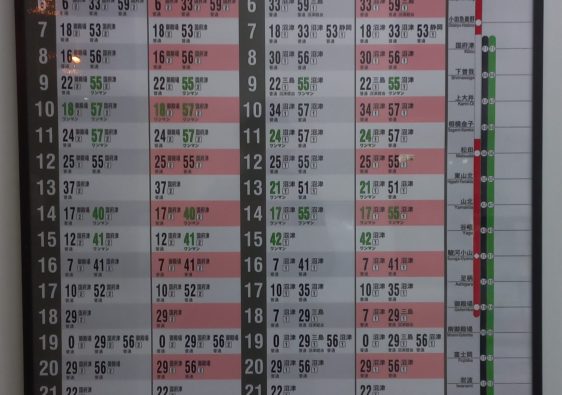
Knowing the time in Japan is not limited to a spindle calculation. Japanese daily rhythms have their own specificities, useful to anticipate for a traveller. Public transport, especially trains and shinkansen, are known for their extreme punctuality: a departure is announced at the nearest minute, and it is common to see a train leaving with a few seconds ahead of the schedule displayed. It is therefore recommended to arrive on the dock at least five minutes before the scheduled time, especially at major stations such as Tokyo, Shinjuku or Osaka.
The hours of shops and restaurants also vary. The konbini, these omnipresent superettes, are open 24 hours a day for the most part. The department stores usually close between 8 p.m. and 9 p.m., while many restaurants, especially those in business areas, close their kitchens at 9 p.m. or 10 p.m. The izakaya and night establishments can remain open much later. For cultural visits, temples and gardens often close between 4 p.m. and 5 p.m., which requires planning its days accordingly. Finally, the time difference itself can disturb the first days: from France, the journey to Japan involves jumping seven or eight hours forward, which causes a time difference easier to manage when returning than when travelling for most travellers, but which still requires one to two days of adaptation.
Knowing what time it is in Japan is therefore both simple and nuanced. Simple, because a single spindle, the JST at UTC+9, governs the entire archipelago, without summer time or local variation. Nuanced, because the lag with France changes at the pace of European seasons, and because Japanese rhythms, from rail punctuality to temple times, have their own logic. A live clock, some seasonal landmarks and a little anticipation are enough to travel calmly and never miss a shinkansen.
If this article has brought you useful information and can help other travellers prepare for their stay, a Google review will always be appreciated. |
|
What time is it in Japan compared to France?
Does Japan apply summer time?
Is there only one time zone for all of Japan?
How to quickly calculate Japanese time from France?
What are the schedules for a trip to Japan?
Is the time on my phone reliable in Japan?
Discover more from Evasions Rebelles - Travel Planner Japon
Subscribe to get the latest posts sent to your email.