Kanazawa is one of the most pleasant Japanese cities to discover for travellers seeking a balance between heritage, art, gardens and preserved atmosphere. Located in Ishikawa Prefecture, on the coast of the Japanese Sea, the city has retained a strong cultural identity inherited from the time of the Kaga estate. Between landscaped gardens, ancient geisha districts, feudal castle and traditional arts, Kanazawa offers a rich and more soothing experience than the large Japanese metropolises.
Kenrokuen, one of the most beautiful gardens in Japan
The Kenrokuen Garden is the iconic site of Kanazawa. Considered one of Japan’s three large landscape gardens, it attracts visitors in all seasons thanks to its carefully composed landscapes.
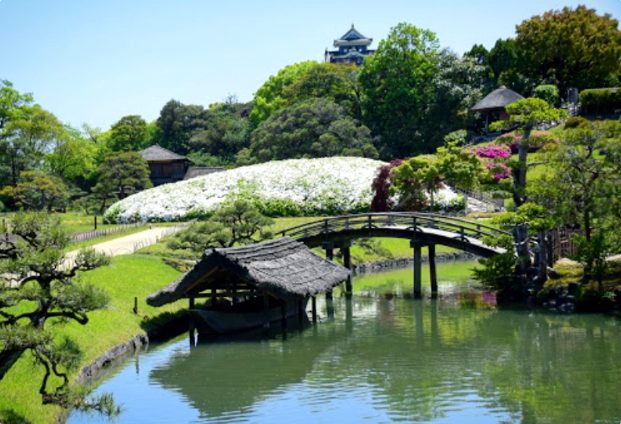
Its name literally means “garden of the six qualities”, with reference to the elements considered essential to the perfection of a Japanese garden: space, tranquility, panoramas, seniority, human ingenuity and the presence of water.
Developed by the Maeda family, which ruled the former Kaga estate, the garden covers more than 11 hectares in the immediate vicinity of Kanazawa Castle. It slowly discovers, along ponds, stone trails, lanterns and tea pavilions.
The large Kasumigaike pond is one of the central points of the garden. In its middle lies Horai Island, symbol of longevity and prosperity in classical Japanese aesthetics. This composition reflects the symbolic importance attached to miniature landscapes in feudal gardens.
Seasons in Kenrokuen
Kenrokuen profoundly changes the atmosphere according to the seasons. In spring, cherry trees and plum trees bring soft colours that are particularly appreciated during flowering.
Summer highlights vast green spaces, water bodies and iris. In autumn, red and orange maples attract many visitors who come to admire seasonal colours.
Winter, however, remains one of the most significant periods thanks to Yukizuri, a traditional technique designed to protect pine branches from the weight of snow. Strings stretched from high bamboo poles create a conical silhouette that has become one of Kanazawa’s visual symbols.
This seasonal diversity makes the garden a relevant visit all year round.
Kanazawa Castle and the Maeda clan heritage
Right next to Kenrokuen is the Kanazawa Castle Park, a former political centre in the Kaga estate.
Although several parts of the castle have disappeared as a result of fire and historical transformations, the site retains a strong architectural presence thanks to numerous reconstructions carried out according to traditional Japanese techniques.
The Maeda clan, one of the most powerful of the feudal era, led this region for nearly three centuries. The castle symbolized both the military power and the cultural prosperity of the estate.
Among the most remarkable structures are the Ishikawa-mon Gate and the Sanjikken Nagaya, both classified as important cultural property. The massive stone walls, white lead tiles and wide defensive spaces recall the strategic importance of the site.
Historical reconstructions of the castle
Kanazawa Castle is distinguished by the quality of its modern reconstructions. Several buildings were recreated identically using ancient Japanese craft techniques.
The Hishiyagura turret, the Gojikken Nagaya warehouse and the Hashizumemon Tsuzuki Yagura defensive tower offer a concrete overview of Japanese military architecture.
The recently rebuilt Kahoku-mon gate also provides a better understanding of the structure of the castle’s fortified access.
These spaces are particularly interesting for visitors wishing to deepen their understanding of Japanese castles beyond the simple outdoor panoramas.
Gyokusen-inmaru Garden and its Illuminations
Inside the castle park is the Gyokusen-inmaru Garden, originally created in the 17th century and rebuilt recently.
This garden has a different style from Kenrokuen, with more marked reliefs, artificial waterfalls and a composition designed to be observed from different angles.
In the evening, some illuminations organised on weekends create a particularly elegant atmosphere, highlighting the stones, water and vegetation of the garden.
For travelers staying several nights in Kanazawa, this night tour is an excellent activity after dinner.
Kanazawa Noh Museum
Kanazawa has a long tradition related to Noh Theatre, especially Hosho School, historically supported by the Kaga estate.
The Museum of Noo allows you to discover this classic Japanese art through costumes, masks and a reproduction of traditional scene.
Even without prior knowledge of Noo theatre, the visit remains accessible thanks to visual explanations and detailed presentation of the stage elements.
The exposed masks impress with their finesse and ability to transmit subtle emotions according to the angle of light.
For travellers interested in classical Japanese arts, this museum perfectly completes the visit to the gardens and castle.
Gyokusen-en Garden and Tea Ceremony
More discreet than Kenrokuen, the Gyokusen-en garden belongs to the Nishida family and offers a more intimate atmosphere.
Created by an ancient vassal of the Maeda clan, this garden highlights a large plant variety as well as a historical Korean pine cultivated for several generations.
The most appreciated experience remains the tea ceremony organized by reservation. In a quiet and refined setting, visitors can discover the gestures, rhythm and codes of Japanese chanoyu.
This activity provides a better understanding of the Japanese relationship to aesthetics, seasonality and hospitality.
Higashi Chaya, the traditional district of Kanazawa
The Higashi Chaya district is one of Kanazawa’s most famous areas. An ancient area of tea and entertainment houses, it preserves many perfectly preserved wooden facades.

The cobbled streets, lanterns and traditional buildings give the neighborhood a particularly photogenic atmosphere, especially early in the morning or evening.
Today, Higashi Chaya houses tea salons, craft shops and cafés in ancient traditional houses.
Kanazawa is known for its craftsmanship and is also an excellent place to discover gold leaf, local ceramics or some lacquered objects.
Practical tips for visiting Kanazawa
Kanazawa is easily visited on foot or by bus. The main tourist sites are located within a relatively compact perimeter, making it easier to organise a stay of two to three days.
Spring and autumn are particularly pleasant to discover the gardens, but winter also has a unique charm thanks to snow and Yukizuri facilities.
To fully enjoy the city’s atmosphere, it is advisable to have at least one night on site rather than a simple excursion from Kyoto or Tokyo.
Kanazawa is also an excellent stop on a route between the Japanese Alps, Takayama or the Noto Peninsula.
Kanazawa seduces by its rich heritage, the quality of its gardens and its elegant atmosphere. Between Kenrokuen, the castle, traditional arts and historical districts, the city offers a deep cultural immersion without the agitation of the major cities. For a trip to Japan combining history, Japanese aesthetics and refined urban discovery, Kanazawa deserves a lot of days of exploration.
If this article has brought you useful information and can help other travellers prepare for their stay, a Google review will always be appreciated. |
|
Discover more from Evasions Rebelles - Travel Planner Japon
Subscribe to get the latest posts sent to your email.