The Supports of the Divine Presence
At the top of the shingu hierarchy are the objects that serve as yorishiro, these supports where the kami is invited to manifest. The most emblematic is the sacred mirror, or shinkyo, a disc of polished metal placed on an open and erect base facing the altar. Its reflective surface symbolizes the clarity of the divine spirit and the power to reveal the truth. In Japanese mythology, it is a mirror that would have attracted the solar goddess Amaterasu out of her cave, and this founding episode explains the central place of shinkyo in the shrines. The mirror is not only an object of worship: it is one of the three imperial treasures, with the sword and jewel, which constitute the regalia of the Japanese imperial house.

Next to the mirror, the masakaki is an evergreen tree, usually sakaki, erected on either side of the altar or ritual space. The right-hand sakaki wears a jewel, a mirror and five-colored silk strips, while the left-hand sakaki wears a sword and the same silk strips. This symmetrical arrangement frames the sacred space and reminds that the kami is welcomed in a vegetal box. The Himorogi, on the other hand, is a tree with persistent leaves temporarily planted for open-air ceremonies, such as field blessings, in order to offer support to the kami invoked outside the enclosure of a permanent sanctuary. These three objects, shinkyo, masakaki and Himorogi, fulfil the same fundamental function: to offer the divine a temporary or permanent residence in the heart of human space.
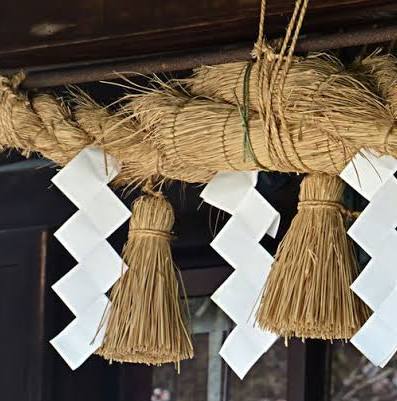
Shimenawa, this string of rice straw braided to the left, marks the boundary between secular space and sacred space. Shids, these strips of white paper folded in zigzag, are inserted to signal the divine presence and to repel harmful influences. They are found at the entrance to the shrines, around the sacred trees, and even above the doors of the houses during the New Year celebrations. The gohei, finally, is a wooden stick topped with shide or strips of gold paper, used as a yorishiro mobile and as an offering. In purification rituals, the priest shakes the gohei above the faithful’ heads to transfer impurities to the strips of paper, which are then thrown or burned.
The receptacles of offerings
Shinsen, these offerings of rice, sake, salt, water and seafood and mountain products, are presented to the kami on codified supports. The sanpo is the most common tray: a white wooden board, often in hinoki, pierced by three side openings called mensho, which are used to let the air pass and lighten the object. Its simple form and natural matter remind us that the offering must remain humble and pure. The oshiki, a ledge tray, and the takatsuki, a standing stand, perform similar functions depending on the nature and size of the offerings.
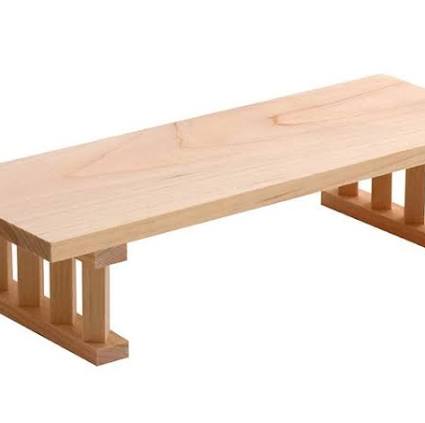
Hassokudai, or eight-foot table, is a white wooden furniture that is used to arrange offerings or to receive tamagushi during ceremonies. Its name comes from the four feet on each side, eight in total, which give it special stability and solemnity. The heishi, these lid ceramic bottles for sacred sake, are usually presented in pairs, one on the left and one on the right of the altar. Mizutama, a round and covered container for water, and hiraka, a flat plate of terracotta or white porcelain, complete this set. The preferred materials are untreated white wood, unglazed terracotta and white porcelain, all chosen for their purity and simplicity, in contrast to the luxurious or colourful objects of the secular world.
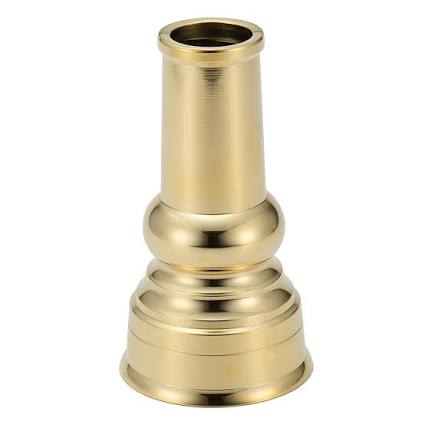
The sakakitate, a lily-shaped vase intended to receive the branches of sakaki, is arranged in pairs on each side of the altar. The choice of white wood is explained by its ability to remain neutral and not to draw attention to itself: the offering must be visible, but the object that supports it must be erased. This sobriety is a constant characteristic of shingu, which favour function and purity over ornamentation. Even the most elaborate objects, such as the three-open sanpo, remain of great formal restraint.
Purification Tools
Purification, or harai, is an indispensable prerequisite for any encounter with the kami. The onusa, often called oharai, is a wooden stick or sakaki branch to which are attached shide and hemp fibres. The priest shakes it from left to right, then from right to left, above people or objects to be purified. This gesture disperses impurities and restores the state of purity necessary for contact with the divine. The onusa is one of the most visible objects of Shinto ceremonies, and its regular swinging rhythm of many public rituals.
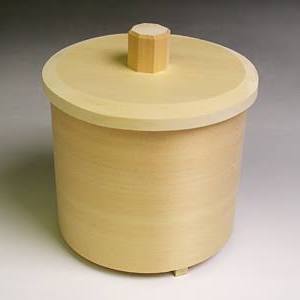
Entou-oke and chozu-oke are buckets intended to contain hot salted water or purification water used for ablutions. Hiuchi-ishi and hiuchi-gama, stone and sickle on fire, used to produce sparks to purify the spaces and ritual instruments. This practice, now rare, bears witness to the importance attached to fire control in purification rituals. Hitogata, or katashiro, is a silhouette of paper cut to the effigy of a person. During the great purification ritual called Oharae, which is held twice a year, in June and December, the faithful enter their name and age, then pass the figurine on their bodies to transfer their impurities there before entrusting it to water or fire. This practice, attested since the time of Nara, remains alive in Japanese shrines.
Salt, often placed in small piles at the entrances of shrines or dissolved in ablution water, is a universal purifier. It is found in the Sumo rituals, where wrestlers launch them before each fight, and in the daily practices of many Japanese homes. Water, in all its forms, also plays a central role: the temizu, this ablution of the hands and mouth at the entrance of the shrines, is the first gesture of purification requested from the visitor. The shingu associated with water, buckets, ladles and basins, although often modest, are therefore essential for access to the sacred.

The shaku and the priest’s fan
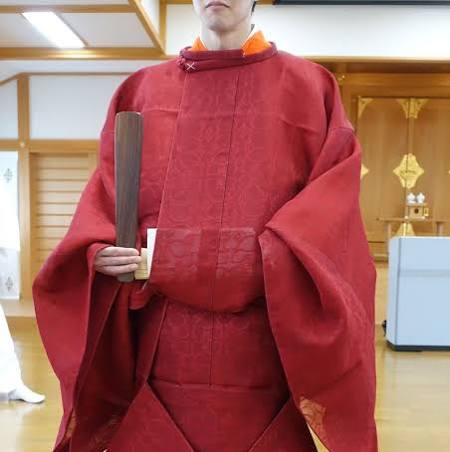
The shaku is an oblong wooden tablet that the priest holds in his right hand when in official dress. Originally, it was probably used as a medium for taking notes during rituals, but it became an attribute of dignity and function. His presence in the priest’s hand indicates his role as intermediary between the faithful and the kami. The hiogi, a folding fan made of hinoki wood, also accompanies the priest in certain ceremonies. The wooden slats that make up it are assembled with a silk thread, and the fan opens with a slight twist that marks the beginning or end of some ritual gestures.
The norito-bukuro is a cloth pouch that contains the norito, these prayers addressed to the kami and read by the priest aloud. The text, written in a classic Japanese which is often difficult to understand for contemporary faithful, is considered to be a performance: to pronounce the norito is to act on the world. The cover protects the text and emphasizes the sacredness of ritual speech. The priest holds it in front of him or the laying on the altar during recitation, according to the protocol of the sanctuary.

Bells, drums and flutes
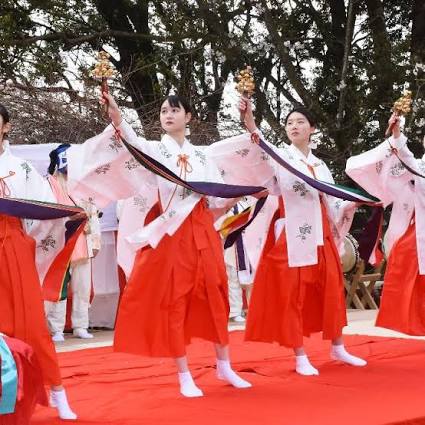
Sound is an integral part of Shinto ritual. The kagura-suzu is a bell with several rows of grelots that the miko, the young women at the service of the sanctuary, shake while dancing during the kagura, these dances offered to the kami. The crystalline sound of the celots is supposed to attract the divine’s attention and create a sacred sound space. The hontsubo-suzu, a large bell hanging under the awning of the Haiden, is operated by the faithful themselves before prayer. The red and white fabric rope that connects it at hand height makes it possible to twist it by pulling it, a gesture that every sanctuary visitor has done at least once.
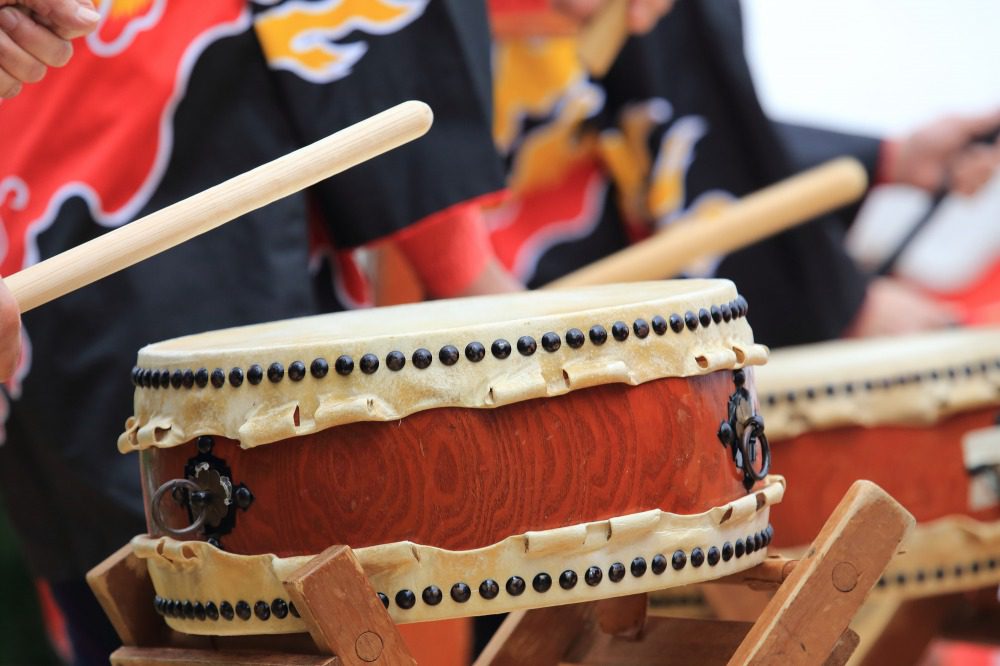
The taiko, traditional drum, and the fue, flute or right flute, accompany the processions and ceremonies. Their role is to rhythmize the ritual time, mark the stages of the ceremony and create a collective atmosphere. During matsuri, these instruments resonate in the streets and attract crowds. The sound of taiko, severe and powerful, is often associated with the presence of kami, while the flute, more acute and melodic, evokes the lightness and joy of celebrations. In shrines, these instruments are carefully preserved and only come out during rituals that require them.
Mikoshi and processions
Mikoshi is probably the most spectacular shingu. This portable palanquin, often decorated with gilding and sculptures, houses the spirit of the kami during the processions, or miyuki, which carry him out of the sanctuary to visit his territory. Weared on the shoulders by a team of faithful dressed in hachimaki and hapi, the Mikoshi swings at the pace of the steps and encouragement of the crowd. Its construction is entrusted to skilled artisans, and some historical Mikoshi are classified as cultural property. The horen, a more imposing chariot reserved for high-ranking deities, is used in some imperial processes or large shrines.
The karahitsu, a standing chest for the transport and storage of ritual objects and treasures of the sanctuary, sometimes accompanies processions. Some karahitsu are richly decorated and testify to the importance of the objects they contain. Toro, stone or metal lantern, kagaribi, a bonfire, and bonbori, a portable paper lantern, illuminate ritual spaces during night ceremonies. The misu, bamboo awning, and the shinzen-maku, a curtain separating the sacred space from the secular space, create visual thresholds that reinforce the solemnity of rituals.
Domestic kamidana
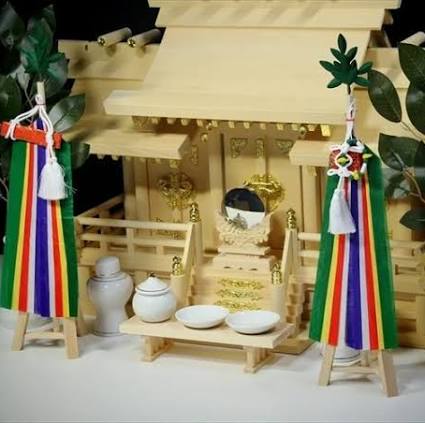
Shingu is not limited to shrines. Many Japanese homes have a kamidana, a high-rise home altar, facing east or south, where miniature ritual objects are arranged. The mirror, the sakaki, the small lanterns and the offerings of rice, salt and water reproduce, on a reduced scale, the arrangement of a sanctuary. Shimenawa, stretched over the kamidana, with its paper shide, delimits the sacred space to the heart of the house. This practice, popularized from the middle of the Edo era, bears witness to the continuity between public worship and private devotion.

The contemporary kamidana adapts to the constraints of modern housing. Manufacturers offer compact models, wall altars and simplified versions that retain the bulk of the ritual device. The objects placed there, although small in size, respect the same principles of material and layout as those of the great shrines. For a guest traveller in a Japanese family, seeing a kamidana is often an opportunity to understand that Shintoism is not only a religion of temples and priests, but also a daily and discreet practice, integrated into the domestic space.
Materials and manufacturing
Shingu are made from materials carefully chosen for their purity and their ability not to corrupt the offering. White wood, usually hinoki or untreated sugi, is the dominant material. Its clear colour and lack of visible knots make it a neutral support, which does not distract attention from the ritual. Unglazed terracotta, called kawarake, is used for plates and small containers for liquid offerings. White porcelain, more resistant and easier to clean, sometimes replaces terracotta in urban shrines. Metal, especially brass, appears in mirrors, bells and some ornaments, but remains a minority.
The manufacturing of shingu is often carried out by skilled craftsmen, sometimes passed on from generation to generation. Major shrines, like Ise’s, command high-quality objects that are renewed during periodic reconstruction ceremonies. These renewals, which take place every twenty years at the sanctuary of Ise, are an opportunity to faithfully reproduce objects whose shape and proportions are fixed by tradition. The ancient objects, charged with the divine presence accumulated over the years, are either burned or buried or distributed to associated shrines. This cycle of renewal perpetuates craftsmanship and guarantees the continuity of ritual forms over centuries.
What the traveller can observe
For the traveller, shingu are everywhere, but often discreet. At the entrance of a sanctuary, the Shimenawa and its shide signal the passage into the sacred space. On the altar of the Haiden, the mirror, the branches of sakaki and the trays of offerings make up a picture whose arrangement follows precise rules. During a public ceremony, the swinging of the onusa, the ringing of the suspended bell, the sound of the taiko and the procession of the mikoshi make it possible to grasp the sensory dimension of the ritual. Shrines sometimes exhibit ancient shingu in their museums or treasures, providing an overview of the evolution of forms and materials over the centuries.

Curious travellers can also visit craft workshops that manufacture shingu, especially in areas renowned for their woodworking. Some shrines offer guided tours that explain the function of ritual objects and the actions that accompany them. The matsuri periods in summer and autumn are particularly conducive to the observation of mikoshi and ritual musical instruments. Apart from these strong moments, a careful visit of a sanctuary, with a little patience and observation, makes it possible to spot the shingu and understand their role in the organization of the sacred space.
Shingu are much more than objects: they are the tools of a relationship, the one that unites the faithful to the divine through gestures transmitted for centuries. From the mirror that welcomes the kami to the paper figure that takes away impurities, each instrument tells a conception of the sacred based on purity, reciprocity and respect. For the traveller, to observe these objects in their context, to understand their function and symbolism, it is to gain access to a dimension of Japan that often escapes tourist routes. The shrines, with their shingu, offer a lesson of sobriety and precision, where every detail counts and where the visible always refers to the invisible.If this article has brought you useful information and can help other travellers prepare for their stay, a Google review will always be appreciated. |
|
What are the main shingu that we see in a Japanese sanctuary?
The most visible objects are the sacred mirror (shinkyo) placed on the altar, the Shimenawa with its shide at the entrance, the branches of sakaki arranged in pairs, the trays of white wood offerings (sanpo) and the onusa that the priest shakes to purify. The large bell hanging under the awning (hontsubo-suzu) and its red and white fabric rope are also familiar to visitors, who operate them before praying. During the ceremonies, the shaku of the priest, the gohei and the instruments of ritual music complete this ensemble.
What’s the difference between a shingu and a shinpo?
The term shingu refers to all the tools and instruments used in shinto rituals, whether ritual furniture, offering containers or purification objects. The narrower term shinpo generally refers to precious objects preserved in the sanctuary, including sacred treasures and regalia. The three imperial treasures, the mirror, the sword and the jewel, are shinpo as well as shingu, for they perform a ritual function while being symbols of sovereignty. The distinction between the two terms remains unclear in current usage, and both are often used interchangeably.
Can we buy shingu outside the shrines?
Yes, some shingu for domestic kamidana are commercially available. Specialized stores and large DIY surfaces offer sets with a small altar, mirror, offering trays and artificial sakaki branches, for a price ranging from 5,000 to 30,000 yen depending on size and quality. The shrines themselves sell simplified ritual objects, such as miniature gohei or shide, which the faithful bring home. On the other hand, the shingu used in the rituals of large shrines are usually made to order and are not marketed to the general public.
How are the shingu maintained and replaced?
White wood shingu are cleaned regularly with a dry cloth and kept away from moisture and direct light. Objects that deteriorate, such as paper shide or sakaki branches, are replaced periodically, often during the big New Year’s celebrations or purification ceremonies. In the great shrines, the major shingu are renewed during periodic reconstructions, such as the one that takes place every twenty years at the sanctuary of Ise. The ancient objects, charged with the divine presence, are burned or buried at specific ceremonies, or distributed to associated shrines.
Are shingu still made using traditional methods?
For major shrines and objects intended for official rituals, traditional methods remain the norm. The wood is worked by hand, without nails or screws, and the proportions are fixed by models transmitted for centuries. The artisans who manufacture these objects, often installed in areas renowned for their woodworking, perpetuate techniques inherited from generation to generation. For domestic kamidana and everyday items, however, industrialised production is frequent. Manufacturers use machines to cut and assemble wood, while retaining traditional shapes and materials.
What is the role of Hitogata in purification rituals?
Hitogata, or katashiro, is a silhouette of paper cut to the effigy of a person. During the great purification ritual called Oharae, which is held twice a year, in June and December, the faithful enter their name and age, then pass the figurine over their bodies to transfer their impurities. The figure is then entrusted to the water of a river or to a ritual fire, taking with it the accumulated soil. This practice, attested since the time of Nara, is considered one of the oldest and most symbolic cleansing gestures of Shintoism, and it remains alive in many Japanese shrines.
Discover more from Evasions Rebelles - Travel Planner Japon
Subscribe to get the latest posts sent to your email.