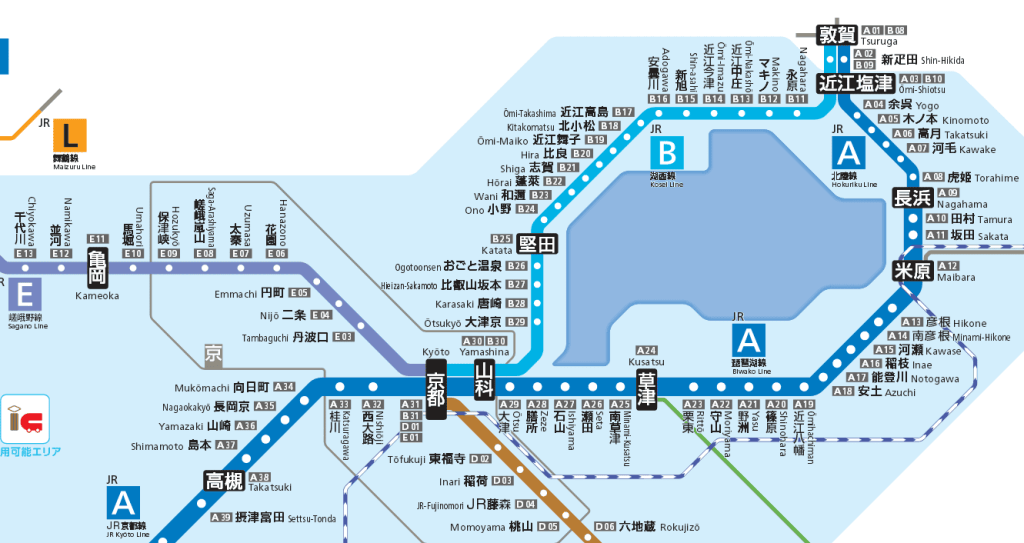
Located about 10 km east of the city of Kyoto in the Kansai region, Lake Biwa is Japan’s largest lake. It has a total area of about 670 km2 and a circumference of about 235 km. The lake supports local life and industry. It is also one of the oldest lakes in the world, more than four million years old. This mother lake is considered a sacred natural environment and houses more than 50 unique species of flora and fauna. Its name appears several times in historical narratives as a popular stage on terrestrial travel routes, and the region has many historical sites, including ancient shrines, temples and remains of castles. The islands on the lake and the surrounding mountains offer beautiful landscapes that have enchanted visitors through the ages. Even the most famous Haiku poet of the Edo period (1603-1868), Matsuo Basho, wrote a poem about Lake Biwa.
Lake Biwa
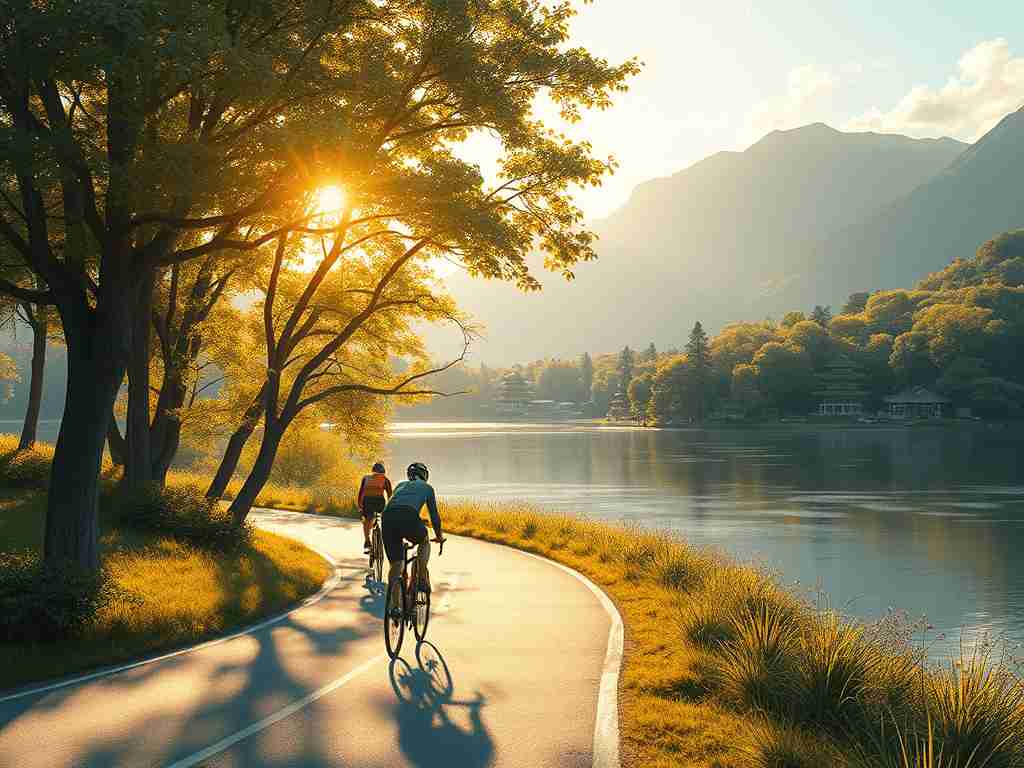
Biwa-ichi is a recent popular activity that includes cycling around the lake. The cycle path of the same name is certified by the national government. For its 230 kilometers, there is an average of 3 days and 2 nights to go around.
Nevertheless, there are many visits and attractions along the lake and it will take at least double to have time to do these excursions.https://biwaichi-cycling.com/en/
Chikubushima
The small island of Chikubushima is a sacred island, accessible from the port of Hikone, where the goddess Benzaiten descended more than 3000 years ago.
Today it is still a Shinto and Buddhist place of worship or pilgrims come to gather each year. Upon arrival, a steep staircase takes you to the sacred enclosure of the Tsukubu Suma, a National Treasure of Japan. Next, a Funa roka corridor (boat corridor) connects the Tsubuku Suma to the Hogonji, whose main hall houses a statue of Benzaiten.
In the temple of Hogonji you can see hundreds of red statuettes with the effigy of Benzaiten, they are darumas (Japanese figurine in papier mâché inspired by boddhidharma). For 500 yen, you will have the possibility to buy one in which you can write a wish before leaving it with others.
There are boats connecting Hikone to the island of Chikubu: the round trip takes 70 minutes, and the island can be visited in just over an hour (3000¥ in total per adult). For more information on rates and schedules, seeOhmi Railway Company website(in Japanese) orpdf document in English.
Nagahama
Nagahama is known for its glassmakers and for its railway station considered to be the oldest railway station in Japan dating from 1882, which can be visited even though the trains no longer pass. In April, the streets of the city were transformed into theatre and concerts and were invaded by children who performed kabuki at the Nagahama Hikiyama festival. For the rest of the year, the tanks are displayed at Hikiyama Hakubutsukan Museum.
Nagahama Hachimangu Sanctuary is a thousand-year-old shrine celebrating Nagahama’s tutelary goddess.
Toyotomi Hideyoshi built Nagahama Castle in 1575. Its castle was destroyed in 1615 and its remains were used to build the castle of Hikone. The present building is a reproduction dating back to the 1980s in the centre of Ho Park.
Maibara
Maibara Station is the only Tokaido Shinkansen station in Shiga Prefecture. The city of Maibara,(HereFor more details) fusion of the cities of Maihara, Santō, Ibuki and d
The castle of Hikone and its Genkyuen
Only 15 minutes from the train stationHikoneThe castle of Hikone is standing in front of the lake. This castle is one of the national treasures of Japan (title it shares only with three other castles, Himeji, Matsumoto and Inuyama).
The Genkyuen Garden is a Japanese landscaped garden with a central pond and circular hiking trail. It was built on the grounds of Hikone Castle in 1677 by the local lord for the entertainment of his guests and family. It is designed after a Tang Palace Garden (China).
The Hikone Castle Museum was inaugurated on 11 February 1987. The museum building, located in Genkyuen, is a reconstruction of the Omote Goten (front hall) of the castle, which was formerly the office of the Hikone fief during the Edo period (1615-1868).
The ticket to visit the castle and garden costs 800 yen. The combined ticket including the museum costs 1200 yen.
Okishima
Okishima Island is located off Lake Biwa, about 1.5 km from the town of Omi-Hachiman. It is the largest island on the lake (a site inscribed with Japanese heritage). It would be the only place in Japan where a freshwater fishing industry has been formed, and the island’s lifestyle is an important cultural heritage. There are also so many cats on the island that it is sometimes called the “city of cats”.
One of the good reasons to go is thefuna-zushi, an old type of sushi prepared since the VIIIecentury with a local carp species callednigoro-buna.
Another reason is the sanctuary of the island, an ancient sanctuary that consecrated one of the three goddesses of the Munakata shrine, Takohimehime, which is the divinity of Okutsunomiya, also known as Okitsu Bimei. From the top of the sanctuary, you have a view of the entire island.
To get there, take a boat from Horikiri harbour to Okishima fishing port.
Shrine Shirahige jinja
The Shrine Shirahige-Jinja is often called “Itsukushima d-Omi”, which recalls the shinto shrine near Hiroshima, a World Heritage Site. The beautiful landscape with its large torii on Lake Biwa is magnificent.
Sakamoto
Satobo is called the buildings in which the monks descended from Mount Hieizan for reasons of age or health. Many of them have stone walls, built by a corporation of stone tailors called the Ano. The landscape of Sakamoto is shaped by these satobo.
Sakamoto is mainly the entrance door to Mount Hiezan where is the Enryakyuji temple. To get there, do not hesitate to take the funicular which is 20 minutes walk from the station of Hiezan-Sakamoto. (return price: 1660 yen).
Go to Lake Biwa
Maibara Station is the only Tokaido station accessible from the cities of the Kansai and Chukyo regions
It takes 19 minutes from Maibara Train Station to Kyoto Train Station, 35 minutes from Maibara Train StationShin-Osaka27 minutes from Nagoya train station via Shinkansen
If this article has brought you useful information and can help other travellers prepare for their stay, a Google review will always be appreciated. |
|
Discover more from Evasions Rebelles - Travel Planner Japon
Subscribe to get the latest posts sent to your email.