The National JR Pass has long been a must to travel to Japan. However, with the increase in its price since October 2023, and a further increase on October 1, 2026, some short-term tourists now favour regional passes or the purchase of single tickets. These passes allow you to control your budget while offering the flexibility necessary to discover different areas of the archipelago. Understanding their characteristics, validity and cost-effectiveness is essential to effectively plan your stay.

Understanding regional train passes
The majority of regional passes offer unlimited access in ordinary class. Here are the rules to know before you buy:
- For the Green Class (first class), a supplement is required.
- Some trains require prior reservation (“Booked Seat Only”), free of charge as part of the pass.
- The purchase is generally restricted to foreign visitors with a non-Japanese passport that is considered a Temporary Visitor.
- The exchange or activation of the pass in Japan requires the presentation of the passport.
- Some passes include discounts in partner restaurants, museums or attractions.
Choose the pass suitable for your itinerary
The choice of a pass depends on the region visited, the length of stay and the time that one wishes to devote to transport. Regional passes often cover major tourist cities such as Tokyo, Kyoto, Nara or Osaka, but their profitability is limited for short intra-urban trips:
For these cities, it is best to use local or day passes and reserve the regional pass to explore the surroundings. Precise planning maximizes the use and economy of the pass.
Once the basic principles are assimilated, let us see the concrete passes, region by region, with their official tariffs updated.
Crossways: connecting east and west
Some passes connect remote regions. They are particularly useful if your itinerary combines Tokyo, Kyoto and the west coast:
The JR Hokuriku Arch Passcovers Tokyo, Osaka, Kyoto, Nara and Kanazawa, including Shinkansen Hokuriku and local JR-East and JR-West trains. Valid 7 days, it costs35 000 ¥ (approximately 210 €)Since 14 March 2026 (compared to 30,000 ¥ previously) and is profitable for multiple trips in the Hokuriku region[citation:2]. For shorter journeys, his interest decreases.
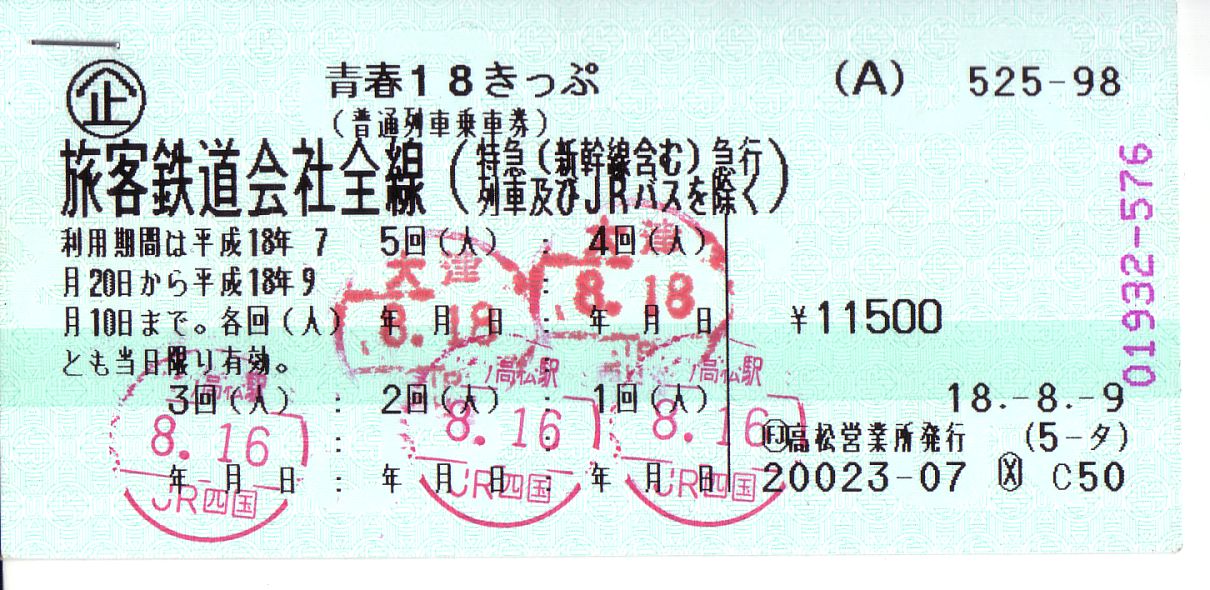
The Seishun 18 Kippuis an economical ticket usable on normal and semi-fast JR trains, suitable for slow travel, but limited in time and coverage Shinkansen. In 2026, it costs10 000 ¥ for 3 consecutive daysand12 050 ¥ for 5 consecutive days, usable only on local and fast trains (no Shinkansen)[citation:21].
Passes for Kansai and western Japan
Kansai and western Honshu concentrate some of Japan’s most profitable passes. The following are the updated official rates:
The JR West Kansai WIDE Area Passcovers Kansai and its surrounding areas to Tsuruga and Takamatsu, including Shinkansen Sanyo (Shin-Osaka – OKama) and several Limited Express trains. Valid 5 days for about12 000 ¥ (approximately 72 €), it becomes profitable on a round trip Shin-Osaka–Okayama[citation:3].
The Kansai Area Pass(more limited) was proposed from 1 to 4 days (2,800 ¥ to 7,000 ¥).Warning: this pass has not been sold since September 30, 2026[citation:23]. If you bought one before that date, it remains valid for the period indicated.
The Koya-san Pass Nankaieasy access to Mount Koya, with train, funicular and bus included for3 140 ¥ (approximately 19 €)Two days. The rates were revised on 1 April 2026, check the exact price on the Nankai site[citation:5].
Sanyo San’in Area Passcovers the west of Honshu to Hakata and Takamatsu, including Shinkansen and local trains, for 7 days at23 000 ¥ (approximately 138 €)[citation:6].
The Setouchi Area Passallows you to discover the inland sea of Seto and the north of Shikoku for 7 days to22 000 ¥ (approximately 132 €)[citation:7].
The Hankyu Kansai Railway Pass / Surutto Kansaioffers unlimited access to the metros and private lines of Kansai over 2 or 3 days, but with travel times often longer than in JR. Count approximately 2,000 ¥ for 2 days (check prices on the Hankyu site).
Passes for Tokyo and East Japan
Tokyo and eastern Japan offer a variety of passes to explore the Kanto region and beyond. The discounted rates are as follows:
The Hakone Free Passallows to visit Hakone over 2 or 3 days, including unlimited transport on all local modes and discounts in tourist sites. From Shinjuku, count7 100 ¥ for 2 days(adult)7,500 ¥ for 3 days[citation:9].
The Hakone-Kamakura Passadds access to the Enoden lines for Kamakura and Enoshima. Count about7 520 ¥for 3 days (check the exact rate on the Odakyu website).
Tobu Nikko Passcovers round trip from Tokyo and local trips, with options of 2 or 4 days. Count3 000 ¥ for 2 days(World Heritage Area) and8 000 ¥ for 4 days(All Area).
The JR East Tohoku Area Passoffers extensive coverage of the Tohoku region for 5 or 10 days. Count30 000 ¥ for 5 daysand48 000 ¥ for 10 days[citation:17].
The JR TOKYO Wide Passcovers Tokyo and its surroundings for 3 days to16 000 ¥ (approximately 96 €), but its use is limited to rapid movements outside Tokaido Shinkansen[citation:16].
If you plan to explore a particular island, dedicated passes exist for Hokkaido, Shikoku and Kyushu.
Passes dedicated to the big islands
Hokkaido, Shikoku and Kyushu each have their own regional passes, with varying rates depending on duration and coverage. Here are the current prices:
All Shikoku Rail Passallows to explore Shikoku with unlimited access to JR trains. Since 1 October 2026, count12 000 ¥ for 3 daysand20 000 ¥ for 7 days(adult tariff, foreign purchase)[citation:19].
The JR Kyushu Rail Passoffers several formulas: All Kyushu (3 days: 22,000 ¥; 5 days: 24,000 ¥; 7 days: 26,000 ¥); Northern Kyushu (3 days: 15,000 ¥; 5 days: 17,000 ¥); and Southern Kyushu (3 days: 12,000 ¥)[citation:28].
The Hokkaido Rail Passallows to explore Hokkaido with unlimited access to JR trains. Rates vary according to duration (4, 5, 7 days); Count about 20,000 to 28,000 ¥ for the most common formulas (check on the JR Hokkaido website).
Okinawa has no rail network: only one monorail line runs in Naha.
Regional passes represent a practical alternative to the national JR Pass, the price of which rose further on October 1, 2026 (7 days: 53,000 ¥)[citation:1]. Their choice must be guided by the length of stay, the type of journey envisaged and the geographical area to be explored. Careful planning saves time and money while allowing you to discover Japan in depth.
|
If this article has brought you useful information and can help other travellers prepare for their stay, a Google review will always be appreciated. |
|
Frequently asked questions about regional passes in Japan
What is the price of the National JR Pass in 2026?
Since October 1, 2026, the JR National Pass (7 days, regular class, adult) costs53 000 ¥ (approximately 318 €), compared with 50,000 ¥ previously[citation:1]. The 14 days increase to 84,000 ¥ and the 21 days to 105,000 ¥. However, a temporary promotion allows you to buy at the old rate via the official website of the JR Pass. For a stay of less than 10 days centered on a region, a regional pass often remains more profitable.
Does the Kansai Area Pass still exist?
No, the JR West Kansai Area Pass has not been sold since September 30, 2026[citation:23]. Passes purchased before that date shall remain valid for the period indicated. To explore Kansai, focus onKansai WIDE Area Pass(5 days, 12,000 ¥), more expensive but much more flexible, or private passes (Hankyu, Hanshin) for urban trips.
Which regional pass is the most profitable for a first trip?
Depends on your itinerary. For a classic Tokyo-Kyoto-Osaka stay, theJR National Pass 7 days(53 000 ¥) remains profitable if you make at least one round trip Tokyo-Kyoto (about 28 000 ¥) plus one trip to Hiroshima or Kanazawa. For a stay centered on Kansai, theKansai WIDE Area Pass(12,000 ¥) is more suitable. For Tokyo and its surroundings (Nikko, Hakone, Kamakura), theJR Tokyo Wide Pass(16 000 ¥ for 3 days) is ideal[citation:16].
Are regional passes valid on the Shinkansen?
Depends on the pass. TheJR National Passcovers all Shinkansen (except Nozomi and Mizuho, for which a supplement is required). TheJR East Tohoku Area Passcovers Shinkansen Tohoku, Joetsu and Hokuriku. TheKansai WIDE Area Passcovers only the Shinkansen Sanyo between Shin-Osaka and Okama[citation:3]. TheJR Kyushu Rail Passcovers the Shinkansen Kyushu. On the other hand, private passes (Hankyu, Nankai, Odakyu) do not give access to Shinkansen.
Can we buy a regional pass on site in Japan?
Yes, most regional passes can be purchased in Japan, at main stations or at JR counters. However, some passes (such as the National JR Pass) are cheaper purchased in advance abroad. For regional passes, compare the online price (often in euros) and the on-site price (in yen): the exchange rate can play for you. Plan your passport for purchase and activation. Some popular passes (Ghibli Park, Fuji-Hakone) are full in high season, book in advance.
What budget for transport in Japan?
Count 1,500 to 3,000 ¥ (9 to 18 €) per day for urban trips (metro, bus). For a 10-day stay with 2-3 cities, a regional or national pass costs between 12,000 and 53 000 ¥ (72 to 318 €). Unit tickets remain competitive for 1 to 2 long trips. A Tokyo-Kyoto in Shinkansen costs about 14 000 ¥ (84 €), a Tokyo-Hiroshima about 19 000 ¥ (114 €). Night buses (3,000 to 6,000 ¥) are an economical alternative for long distances. Provide a margin of 10 to 15% for unforeseen events.
Discover more from Evasions Rebelles - Travel Planner Japon
Subscribe to get the latest posts sent to your email.