Miko is the term for young women dressed in red and white who serve Shinto deities by working in shrines. Behind their recognizable silhouette is a history of more than a thousand years, from sacred dances to religious functions, from mythological figures to contemporary realities of a often seasonal profession. Understanding who the miko are, what they do and how they become, allows us to grasp an essential part of Japanese spirituality, the one that connects humans to the Kamis through gesture, dance and speech.
Miko, kami maids
The termmikomeans a woman who serves the gods of the Shinto, mainly in the shrines. It’s also calledMayhimeormikanko, and the word can be written with the only character . For centuries, the mikos have executedkagura, these sacred dances intended to entertain and satisfy the Kamis, led exorcisms, practiced divinations and served as mediums. Considered to have magical powers, they performed various ritual functions within their sanctuary.
Today, the Miko are responsible for executing kagura and other ritual dances on special occasions, and for assisting the priests of the sanctuary in their duties. We often see them sellingommoriandomikujiin the shrines, but their role is not limited to the sale: they participate in ceremonies, prepare offerings, assist priests in weddings and blessings, and ensure the daily good running of the place. Some Buddhist temples also employ young women wearing a similar outfit, consisting of a white dress and a red hakama.

Folklorists Kunio Yanagita and Taro Nakayama proposed a classification of mikos into two main types:kannagi, from the shamanic court tradition, and thekuchiyosis, popular mediums. According to Yanagita, the first are called miko in the Kantō region andichikoin the region of Kyoto-Osaka, while the second are called miko in Kansai, ichiko orazusamikoaround Tokyo, anditakoin Tōhoku. This distinction reflects the diversity of practices and designations across regions, although all share a role of mediation between humans and the divine world.
History of Miko
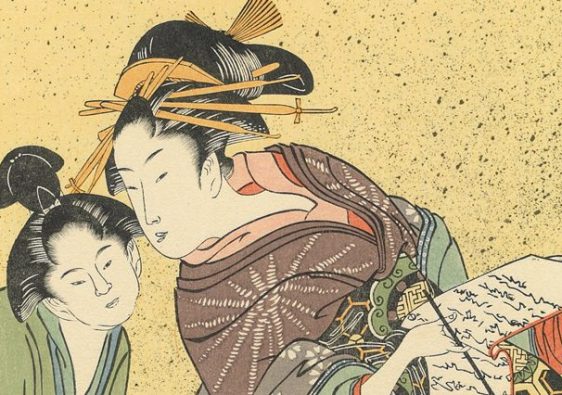
At the origin of Shinto, among the acts intended to appease the Kamis, the ritual of divine invocation or possession (kamigakari), during which a healer or priest served as a receptacle for a divinity, was calledkannagi. Women who presided over this ritual are considered the ancestors of the Miko. Men who performed similar functions were calledkagami. In Japanese mythology ofKojikiandNihon ShokiOne finds a prototype of the miko in the person of Soul-no-Uzume, who would have danced in front of the celestial cave to attract the goddess of the sun Amaterasu out of his retreat.
In Heian’s time, theJingikan, the Shinto Affairs Department, had posts ofmikannagiandSarume-no-kimi, the latter being considered a descendant of Ame-no-Uzume. These women participated in kagura dances and court ceremonies. In theShin Sarugaku Kiby Fujiwara no Akihira, at the end of Heian’s time, the four essential elements of a miko are listed: divination, divine play, string music, and spirit pipe. The author describes the dances he attended as immortal beings playing with the gods.
From the Middle Ages, the mikos used to dance kagura in influential shrines throughout Japan. Kagura has evolved beyond traditional invocation rituals to include prayers for material benefits, lion dances and acrobatic performances. It was also at this time that Izumo no Okuni, considered the creator of thekabuki odori, the ancestor of the kabuki, who was allegedly miko at the shrine of Izumo. This filiation suggests that ancient magic movements were refined into sacred art before spreading among the population as entertainment.

At the beginning of the Meiji era, the government reorganized the shrines and rites. In 1873, the Ministry of Education prohibited the practices of popular mikos, including possession and transmission of oracles, in an ordinance known as the “law prohibiting mikos”. This has led to the disappearance of many traveling Mikos, but some have continued their activity in Shinto shrines or sects. Later, shrines began to employ miko as auxiliary priests, and figures like Tomita Mitsuyoshi of the Kasuga shrine worked to restore the dances of miko, while the musician of the Takemoto Tadayasu court composed theUrayasu no May, a dance still performed today.
Traditional clothing and hairdressing
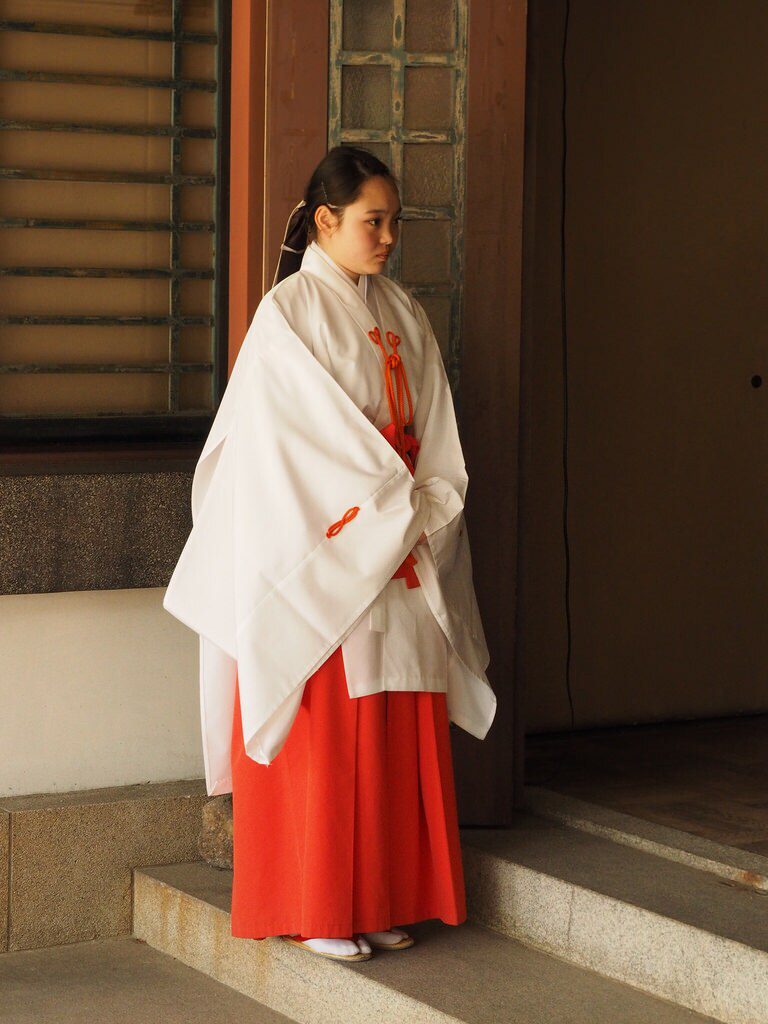
The miko wears a white dress (hakui) with a pair of red hakama (habakama). When performing dances or kagura, she adds achihayawhite, a large jacket with long sleeves of kimono type, over its usual outfit. Its long black hair must be attached in a simple low horse tail, held either by atakeaga, a Japanese washi paper ribbon, either by amizuhiki, a twisted washi cord under which is wrapped a sheet of white washi paper.
During rites and certain events, miko can also wear floral postiches (Hanakanzashi) or a diadem (kanmuri). The flowers, branches of trees and floral motifs used in these rooms are representative of the many types of plants in Japan, which are said to increase the spiritual power of the one carrying them. The details of the outfit change according to the occasion, season, region and sanctuary: there is not a single appearance for the miko. However, makeup and jewellery remain prohibited for all.
Historically, the hakama was of typeMachi-ari, with a closed bottom. In the Meiji era, teacher Shimoda Utako invented theAndon-bakama, an open hakama for the students, which was then adopted by the miko. Today, the andon type hakama is common, but some shrines retain the traditional model, especially for kagura dances, where the freedom of leg movement is essential. Some shrines also use a color hakamakokiA purple red for young women.
The ritual objects of the miko
The objects used in rituals or dances performed by miko are calledtoributsuand includes nine distinct elements:sakaki(sacred branches with persistent leaves), thenusa(stick with woven paper banners), thetsue(a stick or a stick), thesasa(a type of bamboo), theyumi(arc, with or without arrows), theken(sword or sword), theHisago(a gourd) and theKazura(a type of creeping plant). According to the sanctuary and rite, some also usesuzu(clos),Aug(folding fans) andGood(lanterns).
ThesakakiPerhaps the most emblematic object: its branches, decorated with strips of paper, serve to purify space and invite the Kamis to descend. Thenusais used for blessings and purifications, and theyumi(arc) can be strained to drive out evil spirits. These objects are not mere accessories: they are charged with ritual meaning and their manipulation requires special training and attention.
How do we get miko?
The conditions for becoming miko are simple: to be healthy mind and body, and to be a young single woman. The retirement age is generally between mid and late 20s. Full-time mikos who reach this age are calledhonshoku mikoand wear a navy blue or green hakama; they perform administrative tasks or teach kagura to the youngest.
Although many Miko are certified priests, this is not an obligation. Girls, nieces or other young women associated with the sanctuary can also work as miko. During New Year’s celebrations or busy periods, many shrines hire seasonal workers, often female students, to help them. With the increase in the number of international visitors, mikos able to speak English are increasingly sought after. Some shrines even offer one-day initiation sessions to discover the profession.

The Mikos Today
Today, the Miko work mainly in Shinto shrines, where they assist the priests, participate in ceremonies and perform ritual dances. Some are employed full-time, others are part-time or seasonal. Their role has evolved over time, but their role of mediation between humans and Kamis remains central. They embody a continuity of more than a thousand years, while adapting to contemporary realities: reception of foreign visitors, presence on social networks, participation in cultural events.
For travellers, crossing a miko in a sanctuary is a common experience, but one that deserves attention. Their outfit, their gestures, their discreet and effective presence contribute to the particular atmosphere of sacred places. Understanding who they are and what they do makes it possible to look at these red and white silhouettes differently, and to measure the depth of a tradition that continues to live on every day.
Miko are much more than folk figures. They are the guardians of a ritual tradition dating back to the origins of Shinto, and actresses of a living spirituality that adapts to modern times. Behind their codified appearance is a history of dances, prayers, purification and transmission. Whether one is believing or simply curious, observing them in a sanctuary is to grasp a fragment of the intimate relationship that the Japanese have with their deities, and perhaps to leave with a finer understanding of what makes the singularity of spiritual Japan.
If this article has brought you useful information and can help other travellers prepare for their stay, a Google review will always be appreciated. |
|
Frequently Asked Questions
Can we become miko without being Japanese?
In theory, there is nothing to prevent a non-Japanese person from becoming miko, but in practice, recruitment is almost exclusively from Japanese women linked to the sanctuary or recruited locally. Miko are used by shrines according to Japanese labour law, and Japanese mastery is essential for daily tasks and rituals. Some shrines offer one-day tourist experiences, such as the Sumiyoshi Taisha sanctuary in Osaka, where visitors can dress up and participate in activities, but these are initiations, not a job.
What is the salary of a Miko in Japan?
The salary of a miko varies according to sanctuary, region and status (full time, seasonal). For seasonal employment, especially during New Year’s Eve, remuneration is usually calculated on an hourly or daily basis, with rates comparable to those of a student job, i.e. approximately 1,000 to 1,500 yen per hour. For full – time Mikos, the monthly wage is often between 150,000 and 250,000 yen, depending on the experience and size of the sanctuary. Benefits sometimes include office accommodation and meals.
What is the difference between a Miko and a Shinto priestess?
The Miko is an assistant to the Shinto priest, who is responsible for ritual tasks, dances and welcoming the faithful. It is not necessarily ordered and does not require a particular qualification. The Shinto Priestess (kannushi), on the other hand, has undergone a specific training, obtained a certification and can officer ceremonies, bless the faithful and manage the sanctuary. Some Miko are also certified priests, but this is not the norm. The distinction is therefore both statutory and functional.
How long can a miko exercise?
The career of a full-time Miko is usually short: it often starts after high school and ends in the middle or late 20s, with marriage or retirement. Some continue after marriage if they teach kagura or hold administrative positions. Seasonal mikos, often female students, work a few weeks during periods of high influx, such as New Year. There is no official age limit, but tradition and social convenience favour youth and celibacy.
Can we photograph a miko in a sanctuary?
Rules vary according to the shrines. In general, photographs are allowed in outdoor spaces, but it is recommended that permission be sought before photographing a miko, especially if she is in the process of being an officer or assisting a faithful person. Some sanctuaries prohibit photos in religious areas or during ceremonies. Flash is often banned. For travellers, discretion and respect remain the best attitude: a miko is not a tourist attraction, but a person who works in a sacred place.
What do the mikos sell in the shrines?
Miko mainly sellsomikuji(papers of fortune) per 100 to 300 yen,ommori(amulets) for 300 to 1,500 yen, andema(votive plates) for 500 to 1,000 yen. They can also offer goshuin (sacred calligraphy) for an offering of 300 to 500 yen, and seasonal objects such as talismans for examinations or road safety. Revenues are used for the maintenance of the sanctuary and for religious activities. The purchase is considered an offering, and it is customary to thank the miko with a slight sign of head.
Discover more from Evasions Rebelles - Travel Planner Japon
Subscribe to get the latest posts sent to your email.