
Despite the fires, earthquakes, wars and extensive modernization projects that have transformed Japan over the centuries, several cities and villages have been able to preserve entire neighbourhoods dating back to the Edo era or older eras. These streets bordered by samurai residences, warehouses, tea houses or thatched farms today offer a concrete overview of the social and urban organization of Japan in the past, and are major steps in understanding the history of the country through its architecture.

Old samurai districts
Hagi
Old castle town
Some alleys lined with white walls and wooden gates of ancient samurai residences are now beautifully preserved in the Jokamachi district of Hagi. Some houses are open to the public.

Kakunodate
Samurai District
A remarkably preserved samurai district, where several old houses are accessible to visitors. The area is also famous for its many cherry trees.

Kanazawa – Nagamachi
Close streets and old houses were preserved in Nagamachi, one of the former Samurai quarters of Kanazawa. The city was the capital of the second richest feudal estate of the Edo era.

Kunisaki Peninsula – Kitsuki
Kitsuki is distinguished by its two samurai districts located on hills surrounding a merchant district in the valley. They are among the most pleasantly preserved ensembles in the country.

Tsuwano – Old Town
The highlight of the old town of Tsuwano is the Tonomachi district, where an island of the old samurai district is particularly well preserved, with its earth walls, historic buildings and a canal populated by carp.

Usuki – Samurai District
The preserved area of the Usuki Samurai district is modest but photogenic. Called Nioza Historical Road, it spans about 200 metres.

Matsue – Samurai District
Some of Matsue’s former samurai residences have been preserved along the lively road north of the castle. Among them is the former residence of Lafcadio Hearn.

Quarters of former merchants
Takayama – Old Town
The narrow streets of the old town are lined with traditional buildings, shops and sake breweries. Some old merchant houses are open to the public.

Kurashiki – Canal District
Many warehouses are preserved along a canal lined with willows. Many have been converted into museums, souvenir shops, shops and cafes.

Uchiko – Yokaichi Old Town
A 600-metre street lined with preserved buildings dating from the time when the small town of Uchiko, on Shikoku, gained international fame thanks to wax production.

Omi Hachiman
In the past, traders in the former Omi province, corresponding to the present prefecture of Shiga, were known throughout the country for their commercial skills. Their hometown, Omi Hachiman, preserves a charming old neighborhood around a picturesque canal.
Bitchu-Takahashi – Fukiya Village
A carefully preserved village, known for the bengara pigment extracted from nearby copper mines. Its isolation in the mountains, about an hour from the centre of Takahashi, contributes to its appeal.

Asuka and Sakurai – Imaicho
More than just a neighborhood, Imaicho is an entire city whose streets lined with traditional machiya houses have been preserved. Some merchant houses are open to visitors.

Nara – Naramachi
Naramachi is the former merchant district of Nara, where several traditional warehouses and residences remain. An old house is accessible free of charge.

Kawagoe – Warehouse District
More than a dozen large warehouses recalling the Edo era are kept along the main street of Kawagoe. Many now house shops and restaurants.

Narita – Sawara
Former rice transport centre to the capital, the historic center of Sawara, in Narita, extends along a canal lined with traditional residences, shops and restored warehouses.

Matsumoto – Nakamachi
Nakamachi-dori Street in Matsumoto is bordered by several well-preserved old buildings, including warehouses now home to small shops, restaurants and ryokan.

Geishas districts
Kyoto – Gion
Hanami-koji Street and Shirakawa area in the Gion district of Kyoto are lined with old buildings, tea houses and restaurants. In the evening, it is sometimes possible to see an apprentice geisha.

Kanazawa – Higashi Chaya
Kanazawa has several geishas neighborhoods with ancient tea houses where geishas still occur today. Two of them are open to the public.
Stage cities
Kiso Valley – Tsumago
An admirably preserved stage town along the ancient Nakasendo, most of which dates from the Edo era, when they served as inn and restaurants.
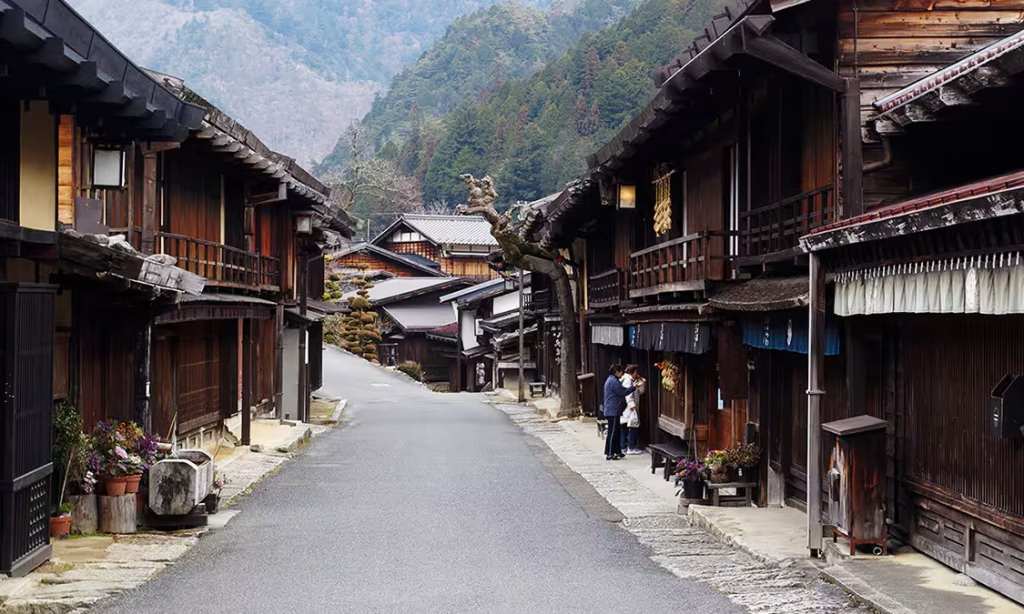
Kiso Valley – Magome
Another well preserved stage town, located about ten kilometers south of Tsumago, also on the ancient Nakasendo. Both localities are connected by a pleasant hiking trail.

Aizu – Ouchijuku
Ouchijuku is an ancient stage town on the Aizu-Nishi Kaido commercial road, connecting Aizu and Nikko during the Edo era. It is about 20 kilometers south of Aizu-Wakamatsu.
Kiso Valley – Narai
Formerly the most prosperous stage town in the Kiso Valley, Narai stretches over more than one kilometre. However, motor traffic is still permitted.

Cities of pilgrimage
Kyoto – Higashiyama
The alleys to Kiyomizudera, one of the most frequented temples in Kyoto, are lined with ancient buildings, shops and restaurants.
Ise Shima – Oharaimachi
Oharaimachi is the old street leading to the inner sanctuary of Ise. It is lined with buildings of Edo style, some authentic, others rebuilt.
Agricultural villages
Shirakawa-go – Ogimachi
The largest village in the Shirakawa-go mountain region, Ogimachi retains numerous massive gassho-zukuri houses in the centre of the village and in an adjacent open-air museum. Spending the night in one of these houses makes it possible to enjoy the atmosphere.

Gokayama – Ainokura
Ainokura is a small isolated village with several gassho-zukuri houses. Some serve as minshuku, offering the possibility to stay there.
Gokayama – Suganuma
The village of Suganuma includes a few gassho-zukuri houses in the remote area of Gokayama, Toyama Prefecture.
Kyoto Prefecture – Miyama
Miyama is a rural town in the mountains north of Kyoto. It has more than two hundred houses with thatched roof scattered in a rural landscape. The hamlet of Kayabuki no Sato has the highest proportion of thatched roofs in the country.
Port cities
Fukuyama – Tomonoura
Tomonoura is a picturesque port town located in a bay of Hiroshima Prefecture, facing the inland sea of Seto. It offers an adjoining maritime landscape and an ancient centre composed of alleys lined with traditional houses. In the past, merchant ships stopped there waiting for a favourable tide.

Near Amanohashidate – Ine
Ine is a unique fishing village, known for its boat houses (funaya) set around a pretty bay. The ground floor was traditionally used as a boat garage, while the floors were fitted out as houses.
Marugame – Honjima
The village of Kasashima, on Honjima Island in the inland sea of Seto, preserves several buildings from the Edo era. Former residents formerly controlled commercial traffic in this strategic area.

Kumamoto Prefecture – Misumi West Port
Misumi West Port was an important port of shipment of coal from Miike mines for a short period from the Meiji era. Several historic buildings remain and contribute to the atmosphere of the site.

Iwami Ginzan – Yunotsu Onsen
Yunotsu is today a spa resort with ancient charm, located along the peaceful coast of the Japanese Sea. In the past, its port exported silver extracted from the mines of Iwami Ginzan.
Villages of Ryukyu
Yaeyama Islands – Taketomi
The village consists almost entirely of traditional houses on one level with roofs of red tiles, surrounded by stone walls, decorated with shisa statues and bordered by white sand paths.
Exploring Japan’s historic neighbourhoods makes it possible to understand the urban and social organization of the Edo era through samurai streets, trading districts, geishas tea houses, agricultural villages and ancient ports. From Kakunodate to Kurashiki, from Tsumago to Shirakawa-go, these preserved places offer an immersion in traditional Japanese architecture, castle towns and old commercial roads. For any heritage-oriented trip to Japan, integrating these historic neighbourhoods allows you to enrich a cultural itinerary, optimize your travels and discover an authentic Japan through its period buildings, preserved urban landscapes and remarkably preserved villages.

Si cet article vous a apporté des informations utiles et peut aider d’autres voyageurs à préparer leur séjour, un avis Google en cliquant sur l’image suivante sera toujours apprécié.

Pour une dose de Japon au quotidien, suivez-nous sur Threads
Discover more from Evasions Rebelles - Travel Planner Japon
Subscribe to get the latest posts sent to your email.


